 Section 01: Introduction
Commissioner's message
It is my honour to present “Promoting a barrier-free Canada,” my 2025–2026 Annual Report.
As I reflect on the past year — my first full year as Accessibility Commissioner of Canada — I feel both the weight of this responsibility and a deep sense of optimism about what Canada can achieve. The goals of the Accessible Canada Act are ambitious, and the work ahead remains significant. Yet I remain hopeful about the direction in which we are moving and the momentum we are building together.
It has now been four years since federally regulated organizations first began developing accessibility plans and reporting on their progress. Many are now entering the next phase of that journey: turning plans into action and action into lasting change. This cultural shift matters.
Real progress begins when organizations stop asking, “What do we have to do?” and start asking, “How do we build accessibility and inclusion from the start and into everything we do?”
This is what building a stronger Canada looks like: a country where everyone has a fair chance to participate, and where human rights help shape how we grow our economy, strengthen our communities, and build a more inclusive future.
This work is especially important at a time when many Canadians are facing cost of living and growing economic uncertainties. People with disabilities continue to experience disproportionately higher rates of poverty, unemployment, and housing insecurity, deepening inequalities and expanding the circle of vulnerability across our country.
As someone who grew up with a disability in a small and often isolated community, I learned early that accessibility is not simply about accommodation — it is about opportunity. It shapes whether people can fully participate in educational and employment opportunities, community life, and leadership roles. I also experienced firsthand the meaningful difference that inclusion, support, and belonging can make in a person's life. Those experiences continue to shape my work as Accessibility Commissioner and reinforce my belief that Canada is strongest when everyone can contribute their talents and ambitions.
Encouragingly, accessibility is increasingly being recognized not as a ‘nice to have,' but as a foundation for economic strength, resilience, and growth. A barrier-free Canada is not only a social good—it's an economic advantage. Accessibility expands our workforce, strengthens our businesses, and drives sustainable growth that benefits everyone.
For individuals, a barrier-free Canada means the opportunity to find meaningful work, earn stable incomes, live independently, and fully contribute talents. When people are empowered to participate, communities become stronger and our economy becomes more resilient.
The Accessible Canada Act exists because people with disabilities across Canada turned lived experience into advocacy, and advocacy into action. The progress we are seeing today is built on decades of leadership, resolve, and the refusal to accept barriers as inevitable.
But regulations alone do not always guarantee meaningful change. That's why the inspections and compliance activities that we are carrying out across federally regulated sectors are so important. They help us better understand where organizations are making progress, where barriers continue to exist, and where additional resources, accountability, or action may still be needed.
In my conversations with organizations over the past year, I have encouraged leaders to see accessibility not as an obligation, but as an opportunity — an opportunity to design services, workplaces, technologies, and communities that work better for everyone from the start.
Ultimately, we want organizations to succeed in this work. Accessibility is not about checking boxes. It is about dignity, independence, belonging, and the full participation of people with disabilities in every part of Canadian life.
By 2040, I want accessibility embedded in how Canada thinks, plans, and leads. That means moving beyond reacting to barriers after they appear and moving confidently toward a culture of inclusion, universal access and belonging across every sector of society.
Canada's future will be shaped by the choices we make today. If we lead with accessibility, inclusion, and human rights, we will not only remove barriers — we will build a stronger, more innovative, and more resilient country for everyone.
Christopher T. Sutton
Accessibility Commissioner of Canada
 Section 02: Accessibility: By the numbers
Accessibility 2025–2026: By the numbers
Over the course of 2025–2026, the Accessibility Commissioner has:

Completed inspections, received complaint and resolved complaints - Text version
- Completed over 250 inspections
- Received 1 complaint
- Resolved 0 complaints*
* Note: In 2025–2026, complaints to the Accessibility Commissioner were limited to organizations' compliance with requirements related to accessibility plans, feedback processes, and progress reports. As new regulations come into force, the scope of complaints under the Accessible Canada Act will expand.
Total number of inquiries
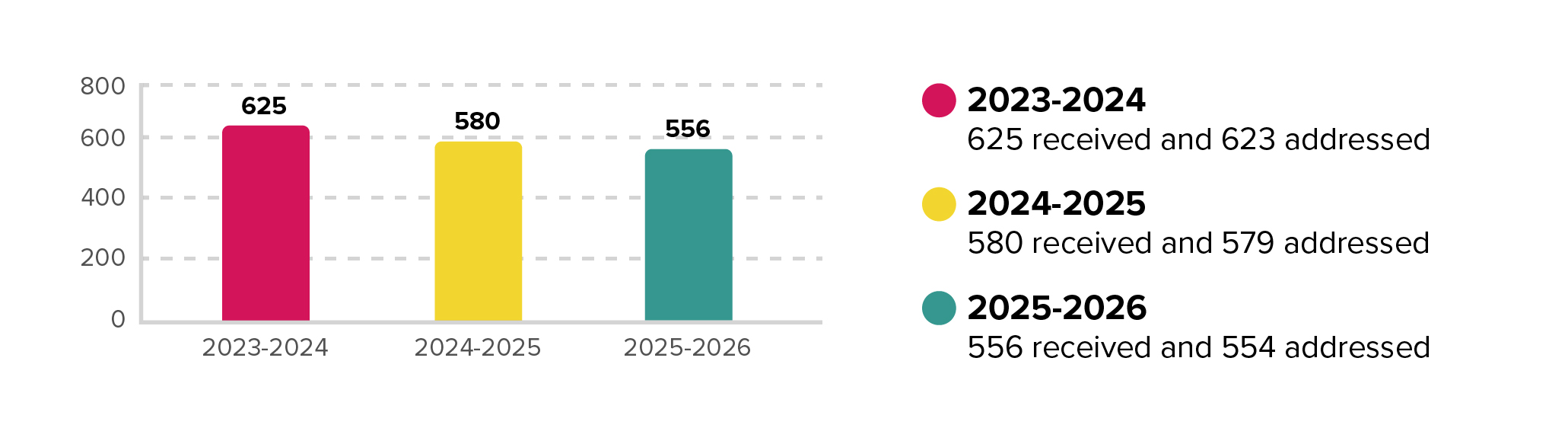
Total number of inquiries over three years - Text version
Total number of inquiries
- 2023-2024 - 625 received and 623 addressed
- 2024-2025 - 580 received and 579 addressed
- 2025-2026 - 556 received and 554 addressed
In 2025-2026, the Accessibility Commissioner initiated inspections of over 250 federally regulated organizations. This included:
- Over 140 publication and notification inspections of federal government and large private sector organizations, assessing compliance with requirements related to accessibility plans, feedback process descriptions, and two progress report deadlines
- Over 95 publication and notification inspections of Crown Corporations and their wholly owned subsidiaries, assessing compliance with the second progress report deadline
- Five content inspections focusing on organizations in the courier services sector
During the same period, over 160 inspections were concluded:
- Over 95 found non-compliance and the organizations have either resolved them or have a corrective action plan in place to resolve them
- Over 30 involve entities that no longer exist or may fall outside of the Accessibility Commissioner's jurisdiction
- The remaining resolved inspections were initiated in the previous reporting period
 Promoting a barrier-free Canada
Improving awareness
The Accessibility Commissioner engaged with key industry groups and national forums to increase awareness of accessibility requirements and support organizations in meeting their obligations.
These discussions addressed emerging and cross-cutting issues affecting people across Canada, including accessibility implications of artificial intelligence, the rapid expansion of digital systems, barriers to accessible communication, and the need for accessible housing and universal design in the built environments.
For example, Commissioner Sutton met with the Canadian Bankers Association and its members to discuss accessibility obligations and emerging trends. He participated as a panellist at the Aviation in Law Conference to highlight regulatory priorities and responsibilities. He also took part in the 2026 Rick Hansen Foundation Accessibility Conference, which brought together architects, engineers, designers, planners, policymakers, accessibility professionals, and corporate leaders to advance accessible design and inclusive spaces.
Through these engagements the Accessibility Commissioner reinforced expectations with sector leaders, emphasized accountability, and promoted a proactive approach to compliance across Canada.
Key insights for regulated organizations
- Focus on root causes, not just individual issues: When concerns, feedback or complaints arise, identify the specific barrier and take steps to address its root cause in order to eliminate it permanently.
- Treat accessibility as an ongoing process: Regularly review your policies, systems, physical spaces and digital tools to ensure organizations identify and address barriers over time.
- Engage people with disabilities early and often: Involve people with lived experience in your consultations, design and testing. This is essential to creating the most meaningful policies that address issues before they affect employees or customers.
- Ensure feedback processes are visible, accessible, and actively used: Make it easy for people to provide their feedback year-round. Actively promote the feedback process, acknowledge input promptly, and explain how the feedback is used. A well designed and trusted feedback process encourages people to participate. It helps address seemingly surface issues early on before they become structural barriers.
- Apply accessibility requirements to third-party providers: Put formal measures in place that require your vendors and third-party providers to meet or exceed your accessibility standards, so your clients consistently receive accessible products and services.
- Embed accessibility through strong governance and accountability: Put clear leadership and executive oversight in place. Consider an accessibility committee, as well as employee and customer feedback mechanisms. Clearly define people's roles and responsibilities to ensure accessibility is integrated across your organization.
Building connections
The Accessibility Commissioner continued to engage with the disability community and stakeholders across Canada.
These conversations ensure that the lived experience and diverse realities of disability rights holders in Canada guide the Accessibility Commissioner's work.
In 2025–2026, the Accessibility Commissioner participated in a range of public forums and events, including:
- AccessFest
- Independent Living Canada
- Canadian Hard of Hearing Association National Conference
- Disability and Work Conference
- National Canada FASD (Fetal Alcohol Spectrum Disorder) Conference
- The Accessibility Standards Canada Board of Directors
- International Week of the Deaf and Sign Languages
- Global Government Digital Summit
- Raising of the Deaf flag on Parliament Hill
- APN's Annual Conference
Empowering organizations to navigate requirements
The Accessibility Commissioner and his team continue to provide organizations and stakeholders with guidance, tools, and resources to support compliance and accessibility requirements.
Examples of key resources:
- Video: Accessibility plan and feedback process description – Learn how to prepare your accessibility plan and feedback process to gain a clearer understanding of the steps involved and best practices for implementation.
- Video: Meaningful consultations – Gain insights into effective approaches for engaging diverse stakeholders and ensuring inclusive participation in the planning process.
- Templates: Accessibility plan – Download the accessibility plan template and follow the included instructions to draft a comprehensive plan that addresses the barriers to accessibility in your organization.
- Templates: Feedback process description – Use the feedback process description template and the corresponding instructions to establish a clear process for individuals to provide feedback on accessibility.
- Instructions: Review the progress report instructions and utilize the progress report template to document the progress on the implementation of the accessibility plan.
Inspiring impactful change
In August 2025, wildfires affected parts of Canada, including Newfoundland and Labrador. During the emergency response, the Government of Newfoundland and Labrador included Sign language interpretation and captioning in televised updates and press conferences. However, some of the interpretation was partially obscured by on-screen elements such as sidebars, weather graphics, and news tickers. In some cases, the captioning was delayed or inaccurate, underscoring the importance of reliable, real-time captioning in emergency communications.
The Accessibility Commissioner raised these concerns directly with the Government of Newfoundland and Labrador.
In his 2025 letter to government officials, Commissioner Sutton noted:
“…in moments of crisis, such gaps are not just inconveniences; they can pose serious threats to safety and survival for thousands of individuals across Canada.”
Following this engagement, the Government of Newfoundland and Labrador took immediate action to address the issues and improve the accessibility of its emergency communications.
This example demonstrates how targeted oversight can lead to immediate, real-world improvements in accessibility, particularly in critical situations.
 Promoting Compliance
Bringing the federal public service on board
The Canadian Government includes over 200 departments and agencies and employs nearly 360,000 employees. It is the county's largest employer, and the largest sector required to comply with the Accessible Canada Act.
In December 2022, federal public service organizations were required to publish their first accessibility plan. At that time, 79% had met this requirement.
By the end of 2025, organizations were required to publish updated plans. Over this reporting cycle, compliance rates among federal organizations increased from 79% to 88%.
| End of 2022 deadline (First planning & reporting cycle) | End of 2025 deadline (Second planning & reporting cycle) |
|---|---|
| 79% of federal public service published their initial accessibility plans on time | 88% of federal public service published their updated accessibility plans on time |
Inspections
The Accessibility Commissioner monitors whether regulated organizations are complying with the Accessible Canada Act (ACA) and its regulations, and whether they are taking steps to identify, remove, and prevent barriers to accessibility. This work is carried out through risk-based inspections that focus resources where they can have the greatest impact on improving accessibility for people with disabilities. In determining inspection priorities, factors such as the number of employees and the delivery of essential services are considered. As additional inspection data is collected, inspection plans will continue to evolve.
Current regulations require federally regulated organizations to develop and publish accessibility plans. In doing so, organizations must:
- consult people with disabilities in the preparation of their accessibility plans and progress reports
- publish accessibility plans outlining identified barriers and the measures to address and prevent them
- establish and publish processes to receive and respond to accessibility-related feedback
- publish progress reports on the implementation of their accessibility plans
- notify the Accessibility Commissioner when they publish their accessibility plans, feedback processes and progress reports
As additional regulatory requirements come into force, the scope of inspections will expand accordingly. For example, recent Accessible Canada Regulations introduced obligations related to digital technologies, including websites, mobile applications, and digital documents. Requirements related to information and communication technologies (ICT) will be implemented gradually, and inspections will evolve to assess compliance as these obligations take effect.
There are different kinds of accessibility inspections:
Publication and notification inspections – Assess whether organizations have notified the Accessibility Commissioner when publishing required documents, in accordance with established deadlines.
Content inspections – Assess the completeness and quality of information in required progress reports, as well as the extent to which organizations are implementing their accessibility plans.
Key findings from 2025-2026 inspections
Overall, 2025–2026 inspections revealed common gaps across organizations, particularly in knowledge and understanding of the regulatory requirements. Tracking these patterns enables the Commission to identify systemic issues and emerging trends, and inform future compliance and outreach efforts.
Accountability issues
Some organizations inappropriately rely on shared accessibility plans and planning documents. Shared plans are only permitted under specific circumstances, such as when organizations share policies and practices, provide similar services, or serve a common clientele. This remains an emerging area requiring further oversight to ensure appropriate use.
Publication and retention issues
Some organizations publish accessibility plans, feedback process descriptions, and progress reports in inaccessible formats. Others fail to maintain these documents publicly (i.e., on their website) for the required seven-year period. Maintaining accessible, publicly available records supports transparency, enables progress tracking, and allows the Accessibility Commissioner to assess compliance over time. The Commissioner has issued guidance to clarify these publishing requirements.
Overlooking transportation
Many organizations identified the priority area of transportation as “not applicable” in their plans and reports. This suggests related accessibility considerations, such as travel policies and event accessibility, may not have been fully assessed. In response, the Commissioner has issued guidance to support a more comprehensive evaluation of this priority area.
Barriers not clearly identified
Some organizations do not clearly identify barriers or link them to specific actions in their accessibly plan. Without this connection, it becomes difficult to track progress in removing barriers. While some actions may improve accessibility, they may not address root causes. Clear identification of barriers is essential in meaningful progress.
Inconsistent structure and required information
The Accessibility Commissioner found some progress reports and related documents to be incomplete or inconsistently structured, including missing headings, incomplete contact information, and inconsistent publication practices. These details matter and affect usability, particularly for people using assistive technologies such as screen readers. It may indicate that key accessibility areas have not been fully considered. Standardized headings, complete information, and consistent formatting are essential to ensure accessibility and transparency.
 New regulations
Information and Communications Technologies
Digital technologies now play a central role in people's daily lives. They are inseparable from the way we access important life services, how we find vital information, and how many of us perform our daily work.
In December 2025, Parliament published new regulations under the Accessible Canada Act (Act). These new regulations relate solely to Information and Communications Technologies (ICT). This is one of the designated areas under the original Act in which organizations must work to prevent barriers.
Once in force, these new regulations will be significant. They will expand the regulatory framework. They will add specific operational requirements for ICT accessibility. Essentially, the regulations require organizations to take steps to identify, remove and prevent accessibility barriers in their information and communications technologies, organized into three categories:
- internal and public-facing websites, new or updated (including web applications)
- public-facing mobile apps
- digital documents published on public-facing websites (e.g., PDF publications, word processing files)
The new regulations also cover supporting requirements for organizations. Examples of supporting requirements include:
- staff training to ensure awareness and implementation of accessibility standards
- conformity assessments, internal compliance checks that organizations must conduct to verify that processes, such as procurement, meet established accessibility requirements
- accessibility statements outlining the accessible features of an organization's web platforms, along with plans and timelines to address any remaining gaps
These regulations will come into force in 2027. By identifying, removing, and preventing accessibility barriers in information and communications technologies, they are expected to improve daily life for many people across Canada. They also represent a significant step forward in modernizing accessibility obligations and will shape how organizations design and deliver digital services in the years ahead.
 About the Accessible Canada Act
The Accessible Canada Act (ACA) is a federal law that aims to identify, remove and prevent barriers faced by people with disabilities. It came into force in 2019, with the goal of creating a barrier-free Canada by 2040.
The ACA applies to all federally regulated organizations, covering approximately 5,000 employers and approximately 1.4 million employees in both the public and private sectors. This includes the federal public service, as well as private-sector organizations such as banks, transportation providers, and telecommunications companies. The Act also applies to First Nations band councils and governments.
Oversight and enforcement of the ACA is a shared responsibility. In addition to the Accessibility Commissioner, several federal organizations play key roles, including the Canadian Transportation Agency, the Canadian Radio-television and Telecommunications Commission, the Federal Public Sector Labour Relations and Employment Board, the Canadian Human Rights Tribunal, the Chief Accessibility Officer, and Accessibility Standards Canada. Together these partners form a coordinated framework to support implementation and oversight of the Act.
The Accessible Canada Directorate within Employment and Social Development Canada works collaboratively with these partners to advance the shared goal of a barrier-free Canada by 2040.
The ACA established a proactive approach to accessibility, requiring organizations to identify, remove, and prevent barriers before they arise. The ACA focuses on barriers in seven priority areas.
The role of the Accessibility Commissioner
The Accessibility Commissioner is responsible for enforcing the Accessible Canada Act and the Accessible Canada Regulations. The Commissioner is a member of the Canadian Human Rights Commission and reports to the Minister of Jobs and Families, who is responsible for the Act.
The Canadian Human Rights Commission supports the Accessibility Commissioner's work by administering, promoting, monitoring and enforcing regulatory requirements, and managing complaints submitted under the ACA
In May 2025, Christopher T. Sutton was appointed as Canada's Accessibility Commissioner. He brings both professional and lived experience, with a lifelong commitment to advancing accessibility as a fundamental human right in Canada. As Commissioner, he is focused on strengthening compliance, promoting a proactive culture of accessibility, and advancing the goal of a barrier-free Canada. Originally from Newfoundland & Labrador, and having lived in British Columbia for several years, he now resides in Ottawa.