Image
© His Majesty the King in Right of Canada, as represented by the Minister of Justice, 2026, ISSN: 2371-8293
This departmental plan details the Canadian Human Rights Commission's (Commission's) priorities, plans, and associated costs for the upcoming three fiscal years.
These plans align with the Commission's Vision, mission, raison d'être and operating context.
The Commission identified the following key priorities for 2026–2027:
The government is committed to restraining the growth of day-to-day operational spending to make investments that will grow the economy and benefit Canadians.
As part of meeting this commitment, the Commission is planning the following spending reductions:
It is anticipated that these spending reductions may involve a decrease in full-time equivalents by 2028–2029; however, planned reductions remain to be finalized as a decision on the Commission's Comprehensive Expenditure Review (CER) proposal is still pending. As such, details are not currently available.
The figures in this departmental plan reflect these reductions.
In 2026–2027, the Commission will advance human rights in Canada through coordinated action across its Core Responsibilities, guided by a “One Commission” approach that promotes alignment, consistency, and shared outcomes across all its mandates. Using this approach, the Commission will strengthen outreach with civil society, governments, employers, rights holders, and regulated entities.
The Commission will support the Pay Equity Commissioner and the Accessibility Commissioner in their continued outreach, compliance promotion, monitoring and oversight, and the publication of guidance to support proactive compliance with both the Pay Equity Act (PEA) and the Accessible Canada Act (ACA). The Commission will also continue to support, the Federal Housing Advocate in her collaborative engagement with communities, civil society organizations, and individuals with lived experience and support an annual systemic housing issue referral to the National Housing Council.
The Commission will update its Complaints Processing Accountability Framework to improve efficiency, prioritize vulnerable complainants and systemic cases, and modernize core tools, while advancing accessible, user-centred digital services, enhanced processing tools, alternative redress and mediation options, and continued jurisprudence development across its mandates under the Canadian Human Rights Act (CHRA), the PEA, and the ACA.
Across its Employment Equity, Pay Equity, and Accessibility mandates, the Commission will advance compliance and oversight by launching audits and publishing related reports, producing guidance and tools to support employer obligations, enhancing digital portals and information management systems, and implementing the necessary policies and systems to support consistent, modern, and data-informed oversight.
Across all core responsibilities, the Commission will emphasize equity, accessibility, digital modernization, early resolution, and strong accountability to strengthen access to justice, enhance compliance oversight, and advance systemic equity.
In 2026–2027, total planned spending (including internal services) for the Commission is $38,268,771 and total planned full-time equivalent staff (including internal services) is 267.
The following provides a summary of the results that the department plans to achieve in 2026–2027 under its main areas of activity, called “core responsibilities.”
In 2026–2027, the Commission, through its various legislative mandates, will continue to provide a national, credible voice for human rights in Canada. The Commission will advance this core responsibility through public awareness initiatives, engagements with civil society and monitoring, advising Parliament on new laws and emerging human rights issues, and reporting on Canada's compliance with international human rights commitments. The Commission will maintain alignment with the Paris Principles, as established by the United Nations General Assembly, reinforcing its independence, credibility, and A-status as Canada's National Human Rights Institution.
As Canada's national human rights institution, the Commission will continue to highlight systemic discrimination and advocate for coordinated government action in line with the pillars of the Second International Decade for People of African Descent (2025–2034). The Commission will also carry out its work with a steadfast commitment to upholding and advancing the rights of Indigenous peoples by promoting equality, addressing discrimination, and supporting the implementation of the United Nations Declaration on the Rights of Indigenous Peoples.
Using a “One Commission” engagement approach, the Commission will strengthen outreach with civil society, governments, employers, rights holders, and regulated entities. This will include targeted meetings and engagements with civil society groups, and sector-specific outreach to promote awareness of rights and obligations across federal human rights and equity legislation.
The Commission will also support engagement and advocacy through public statements, reports, parliamentary communications, newsletters, media relation efforts, social media, and website content, with a focus on increasing reach and public awareness of human rights issues.
In its role as the National Monitoring Mechanism, the Commission will continue to monitor progress and report on whether the Government of Canada is doing all it can to meet its human rights obligations as outlined in the United Nations Convention on the Rights of Persons with Disabilities (UNCRPD).
In support of the Pay Equity Commissioner and Accessibility Commissioner mandates under the Pay Equity Act (PEA) and the Accessible Canada Act (ACA), the Commission will continue outreach, compliance promotion, and the publication of guidance to support understanding and proactive compliance.
The Federal Housing Advocate will continue collaborative engagement with communities, civil society organizations, and individuals with lived experience and support one annual systemic housing issue referral to the National Housing Council.
More information about Engagement and Advocacy can be found in the full plan.
In 2026–2027, the Commission will continue to provide people in Canada with accessible, fair, and efficient mechanisms to file and resolve complaints under the Canadian Human Rights Act (CHRA), PEA, and ACA, while representing the public interest in advancing equity.
Processing of complaints under the CHRA will continue to be guided by the Commission's Complaints Processing Accountability Framework and Anti-Racism Action Plan. Continued emphasis will be placed on prioritizing barrier removal for Indigenous, Black, racialized, and other equity-deserving groups through trauma-informed and culturally responsive approaches. The Commission will update its processes to further improve efficiency, prioritize vulnerable complainants and systemic cases, and modernize core tools, including updated CHRA Complaint Rules. The Commission will also strengthen referral pathways to external supports, and enhance staff training in equity, bias awareness, and trauma-informed practice.
For disputes under the PEA, the Commission will continue delivering efficient accessible and user centred digital solutions, alternate redress mechanisms, mediation, and jurisprudence development.
For complaints under the ACA, the Commission will advance accessible, user-centred digital solutions, develop processing tools, and promote early resolution through mediation.
More information about Complaints can be found in the full plan.
In 2026–2027, the Commission will strengthen proactive compliance, oversight, and auditing activities to ensure federally regulated entities meet their obligations under the Employment Equity Act, the PEA, and the ACA.
In support of the implementation of the Employment Equity mandate, the Commission will launch new audits, issue individual employer audit reports across the public and private sectors and draft a sector-wide horizontal audit report on racialized people in the ground transportation sector.
In support of the implementation of the Pay Equity Commissioner's mandate, the Commission will continue producing guidance and tools to promote compliance; advance the Annual Statement Portal to support employer reporting and data analysis; finalize and implement the Administrative Monetary Penalties policy and system; and launch the Pay Equity audit function to strengthen oversight.
In support of the implementation of the Accessibility Commissioner's mandate, the Commission will continue to promote the use of the My Accessibility Portal; enhance information management systems to support communication, compliance promotion, monitoring and oversight, and complaint handling; and develop and implement programming to monitor and oversee compliance with new accessibility regulations.
More information about Proactive Compliance can be found in the full plan.
For complete information on the Commission's total planned spending and human resources, read the Planned spending and human resources section of the full plan.
It is my pleasure to present the Canadian Human Rights Commission's Departmental Plan for fiscal year 2026–2027.
As Canada navigates some of the most significant challenges in our history, there is a pressing need to hold firmly to the human rights commitments that have long defined and strengthened who we are as a nation.
In 2026–2027, the Canadian Human Rights Commission will advance a more unified and coordinated approach, with a sharper focus on mandate and impact. Through a "One Commission approach", we are aligning our work across all mandates toward our shared mission to protect and promote human rights in Canada. We are building the agility needed to respond to new challenges, while focusing our efforts where they matter most to deliver results that meaningfully address the human rights challenges facing people in Canada.
Through collaboration among our statutory office holders–including the Accessibility Commissioner, the Pay Equity Commissioner, and the Federal Housing Advocate–and across the Commission's dedicated staff, we will continue to advocate for human rights, and provide oversight and dispute resolution processes that are fair, equitable, and respect the inherent dignity of all. We will advance human rights in Canada by representing the public interest, identifying emerging issues and advocating for change that keeps pace with society so that Canada is inclusive, equitable and barrier-free.
The Commission will continue to work closely with partners in civil society, governments, employers, and federally regulated organizations, while strengthening engagement with rights holders and people with lived experience.
Across all our work, we are guided by our vision for Canada as an inclusive society where everyone is valued and respected, and has access to equal opportunities, free from discrimination.
Sincerely,
Charlotte-Anne Malischewski
Interim Chief Commissioner
Canadian Human Rights Commission

Charlotte-Anne Malischewski
Interim Chief Commissioner
Provide a national, credible voice for equality in Canada by raising public awareness of human rights issues; engaging civil society, governments, employers and the public to affect human rights change; and monitoring and reporting on the implementation of the Government of Canada's obligations under the United Nations Convention on the Rights of Persons with Disabilities.
This Core Responsibility contributes to the “Good Governance” domain of the Quality of Life Framework for Canada and, more specifically, “Discrimination and unfair treatment,” “Access to fair and equal justice,” and “Confidence in institutions,” through all the activities mentioned in the Core Responsibility description.
This Core Responsibility also contributes to the “Prosperity,” “Health,” and “Society” domains of the Quality of Life Framework for Canada and, more specifically, “Functional health status,” “Children vulnerable in early development,” “Economic security and deprivation,” and “Self-rated mental health,” through advocating for equality in Canada.
This section presents details on the department's indicators, the actual results from the three most recently reported fiscal years, the targets and target dates for Engagement and Advocacy. Details are presented by departmental result.
Table 1 provides a summary of the target and actual results for each indicator associated with the results under Engagement and Advocacy.
| Departmental Result Indicators | Actual Results | 2026–2027 Target | Date to achieve target |
|---|---|---|---|
| Maintain A-status accreditation as Canada's national human rights institution |
|
A-status | March 2027 |
Table 2 provides a summary of the target and actual results for each indicator associated with the results under Engagement and Advocacy.
| Departmental Result Indicators | Actual results | 2026–2027 Target | Date to achieve target |
|---|---|---|---|
| Number of Canadians who have been informed about the Canadian Human Rights Act, the Employment Equity Act, the Pay Equity Act, and the Accessible Canada Act |
|
At least 3.6 million | March 2027 |
Table 3 provides a summary of the target and actual results for each indicator associated with the results under Engagement and Advocacy.
| Departmental Result Indicators | Actual Results | 2026–2027 Target | Date to achieve target |
|---|---|---|---|
| Number of interventions in the public interest before the Canadian Human Rights Tribunal and the Courts |
|
At least 250 | March 2027 |
Note: This indicator was added in 2023–2024; results are not available for preceding years.
Additional information on the detailed results and performance information for the Commission's program inventory is available on GC InfoBase.
The following section describes the planned results for Engagement and Advocacy in 2026–2027.
Results we plan to achieve:
In 2026-2027, the Commission will continue to adhere to the Paris Principles and maintain its A-status designation.
Results we plan to achieve:
Influencing Law & Advancing Human Rights
In 2026–2027, the Commission will continue to help shape the human rights agenda in Canada through engagement with the international human rights community, public service networks, law practitioners, lawmakers, Parliament, government, civil society organizations and communities of practice. More specifically, the Commission will:
Advancing Employment Equity
In 2026–2027, the Commission, in support of its mandate under the EEA, will:
Advancing Pay Equity
In 2026–2027, in support of the Pay Equity Commissioner's mandate, the Commission will:
Advancing Accessibility
In 2026–2027, in support of the Accessibility Commissioner's mandate, the Commission will:
Advancing Housing Rights
In 2026–2027, the Federal Housing Advocate (FHA), supported by the Office of the Federal Housing Advocate, will:
Results we plan to achieve:
In 2026–2027, the Commission will continue to influence law and advance human rights, employment equity, pay equity, and accessibility through strategic interventions, litigation, and public decisions that promote systemic change. More specifically, the Commission will:
In 2026–2027, the Commission will continue to apply an intersectional lens, including Gender-based Analysis Plus (GBA Plus), to plan, deliver, and evaluate engagement, advocacy, and program activities, ensuring that intersecting forms of discrimination affecting diverse groups—including women, gender-diverse people, Indigenous peoples, and other marginalized communities—are fully considered.
To support data-driven insights, the Commission will work to enhance its data collection capacity in order to collect and disaggregate human rights complaints data, to identify barriers, and improve accessibility for rights holders. Where data collection gaps exist, the Commission is committed to improving mechanisms to capture disaggregated data and integrate gender and diversity analysis.
Inclusive engagement practices with civil society will be strengthened to ensure diverse voices are represented, including inviting feedback on complaint forms, CHRA Complaint Rules.
Under the Federal Housing Advocate's mandate, GBA Plus will continue to guide the assessment of systemic housing issues, with a focus on how housing barriers uniquely affect marginalized groups, particularly women, gender-diverse people, and persons with disabilities. Disaggregated data on gender, disability, and indigeneity will inform monitoring, reporting, and advocacy to support inclusive policy development and equitable outcomes.
Table 4 provides a summary of the planned spending and full-time equivalents required to achieve results.
| Resource | Planned |
|---|---|
| Spending | $6,029,311 |
| Full-time equivalents | 35 |
Complete financial and human resources information for the Commission's program inventory is available on GC InfoBase.
Engagement and Advocacy is supported by the following program:
Additional information related to the program inventory for Engagement and Advocacy is available on the Results page on GC InfoBase.
Provide people in Canada with a mechanism to file and resolve complaints under the Canadian Human Rights Act, Pay Equity Act, and Accessible Canada Act, and to represent the public interest in achieving equality in Canada.
This Core Responsibility contributes to the “Good Governance” domain of the Quality of Life Framework for Canada and, more specifically, “Discrimination and unfair treatment,” “Access to fair and equal justice,” and “Confidence in institutions,” through all the activities mentioned in the Core Responsibility description.
This section presents details on the department's indicators, the actual results from the three most recently reported fiscal years, the targets and target dates for Complaints. Details are presented by departmental result.
Table 5 provides a summary of the target and actual results for each indicator associated with the results under Complaints.
| Departmental Result Indicators | Actual Results | 2026–2027 Target | Date to achieve target |
|---|---|---|---|
| Percentage of complaints completed by the Commission |
|
At least 90% | March 2027 |
Table 6 provides a summary of the target and actual results for each indicator associated with the results under Complaints.
| Departmental Result Indicators | Actual results | 2026–2027 Target | Date to achieve target |
|---|---|---|---|
| Mediation settlement rate |
|
At least 55% | March 2027 |
Additional information on the detailed results and performance information for the Commission's program inventory is available on GC InfoBase.
The following section describes the planned results for Complaints in 2026–2027.
Results we plan to achieve:
Complaints under the Canadian Human Rights Act (CHRA)
In 2026–2027, for complaints under the CHRA, the Commission will:
Complaints under the Pay Equity Act (PEA)
In 2026–2027, for complaints under the PEA, the Pay Equity Commissioner (PEC) will implement leaner and more efficient Pay Equity (PE) dispute resolution process for employees, bargaining agents, and employers (collectively “workplace parties”). More specifically, the PEC will:
Complaints under the Accessible Canada Act (ACA)
In 2026–2027, for complaints under the ACA, the Accessibility Commissioner (AC) will ensure the process for filing ACA complaints is expeditious, accessible, and easy to understand. More specifically, the AC will:
Results we plan to achieve:
Complaints under the Canadian Human Rights Act (CHRA)
In 2026–2027, the Commission will:
Complaints under the Pay Equity Act (PEA)
In 2026–2027, under the PEA, the Pay Equity Commissioner will:
Complaints under the Accessible Canada Act (ACA)
In 2026–2027, the Accessibility Commissioner will promote mediation as a tool for early resolution of ACA complaints.
The Commission continues to use gender-inclusive language in its forms, letter templates, and communications to respect diversity, equity and inclusion. As new tools and processes are implemented or updated, they will contain important complainant information, including access needs, and pronoun and language preferences. The Commission will also engage user testers with diverse lived experiences to help inform systems and process improvements across all complaints mandates.
Employees will continue to receive GBA Plus training, including trauma-informed approaches.
The Commission will continue to monitor and assess the effectiveness of its Accountability Framework, ensuring that multidisciplinary teams with varied lived experiences contribute to CHRA complaint processes. To further promote inclusion, GBA Plus, including inclusion, diversity, equity, accessibility and anti-racism lenses, will continue to be applied when evaluating the framework's impact. This approach will help identify barriers faced by equity-deserving groups while supporting the design and delivery of CHRA complaints programming, ultimately enhancing access and reducing barriers for those who need the system most. Engagement with civil society organizations will continue throughout the fiscal year to seek input as needed.
The Commission will also revisit, and update training materials related to the processing of race-based complaints to ensure they remain current and effective.
Table 7 provides a summary of the planned spending and full-time equivalents required to achieve results.
| Resource | Planned |
|---|---|
| Spending | $12,503,045 |
| Full-time equivalents | 85 |
Complete financial and human resources information for the Commission's program inventory is available on GC InfoBase.
Complaints are supported by the following program:
Additional information related to the program inventory for the Commission is available on the Results page on GC InfoBase.
Ensure federally regulated organizations comply with the requirements set out in the Employment Equity Act, Pay Equity Act, and the Accessible Canada Act and hold those who do not comply accountable.
The Core Responsibility contributes to the “Prosperity” domain of the Quality of Life Framework for Canada, more specifically “Household income,” “Productivity,” and “Firm growth.”
This Core Responsibility also contributes to the “Health,” “Society,” and “Good Governance” domains of the Quality of Life Framework for Canada through all the activities mentioned in the Core Responsibility description.
This section presents details on the department's indicators, the actual results from the three most recently reported fiscal years, the targets and target dates for Engagement and Advocacy. Details are presented by departmental result.
Table 8 provides a summary of the target and actual results for each indicator associated with the results under Proactive Compliance.
| Departmental Result Indicators | Actual Results | 2026–2027 Target | Date to achieve target |
|---|---|---|---|
| Number of employment equity goal setting reports validated for conventional and horizontal audits |
|
At least 15 | March 2027 |
Note: This Departmental Result was introduced in 2023–2024; results are not available for preceding years.
Table 9 provides a summary of the target and actual results for each indicator associated with the results under Proactive Compliance.
| Departmental Result Indicators | Actual results | 2026–2027 Target | Date to achieve target |
|---|---|---|---|
| Percentage of stakeholder feedback indicating satisfaction with support and guidance provided |
|
At least 70% | March 2027 |
Note: This Departmental Result was introduced in 2023–2024. The methodology for calculating it was updated in 2024–2025; therefore, results are not available for 2022–2023, and comparisons with previous years cannot be made.
Table 10 provides a summary of the target and actual results for each indicator associated with the results under Proactive Compliance.
| Departmental Result Indicators | Actual results | 2026–2027 Target | Date to achieve target |
|---|---|---|---|
| Percentage of regulated entities that are using my Accessibility Portal |
|
At least 80% | March 2027 |
Note: This indicator was added in 2023–2024; results are not available for preceding years.
Additional information on the detailed results and performance information for the Commission's program inventory is available on GC InfoBase.
The following section describes the planned results for Proactive Compliance in 2026–2027.
Results we plan to achieve:
In 2026–2027, as part of its mandate under the Employment Equity Act (EEA), the Commission will:
Results we plan to achieve:
In 2026–2027, in support of the Pay Equity Commissioner's mandate, the Commission will:
Results we plan to achieve:
In 2026–2027, in support of the Accessibility Commissioner's mandate, the Commission will:
The Commission will continue to apply GBA Plus and an intersectional lens to ensure proactive compliance initiatives address the unique barriers faced by diverse groups.
Pay equity efforts specifically target gender-based discrimination arising from the undervaluation of work traditionally performed by women. Upon completion of a pay equity exercise under the PEA, all incumbents in female-predominant jobs found to be underpaid—including workers from marginalized groups—would benefit from necessary adjustments.
The Commission recognizes that people with disabilities often belong to other equity-deserving groups, including women, Indigenous peoples, racialized groups, and 2SLGBTQI+ people. Accordingly, the unique barriers faced by individuals from diverse communities and with different lived experiences must be considered. Compliance efforts will continue to apply an intersectional approach aligned with the principles of the ACA.
Table 11 provides a summary of the planned spending and full-time equivalents required to achieve results.
| Resource | Planned |
|---|---|
| Spending | $8,307,970 |
| Full-time equivalents | 53 |
Complete financial and human resources information for the Commission's program inventory is available on GC InfoBase.
Proactive Compliance is supported by the following program:
Additional information related to the program inventory for Proactive Compliance is available on the Results page on GC InfoBase.
Internal services are the services that are provided within a department so that it can meet its corporate obligations and deliver its programs. There are 10 categories of internal services:
This section presents details the department's plans to achieve results and meet targets for internal services.
In 2026–2027, the Commission will continue to prioritize the development, updating, and implementation of standardized tools, systems, and guidelines to strengthen internal capacity, optimize performance, and improve service delivery.
Under its Digital Strategy, the Commission will continue to deploy modern and accessible digital tools for internal and external groups, advance the standardization of its case management systems, maintain a modern, reliable, and secure information technology infrastructure, and strengthen the effective management and use of data and information.
The Commission will continue to advance its IDEA-AR (Inclusion, Diversity, Equity, Accessibility, Anti-Racism) priorities, investing in initiatives that strengthen diversity in leadership, remove barriers to advancement, and foster a more inclusive workplace. Key efforts will focus on embedding IDEA-AR principles into governance structures, performance management, and leadership development. The Commission will maintain commitments to mentorship and sponsorship of equity-deserving groups, provide job-specific learning on anti-racism, accessibility, and allyship.
Building on progress from previous years, the Commission will continue implementing actions outlined in its Anti-Racism Action Plan and explore developing an integrated IDEA-AR strategy to provide overarching strategic direction.
Implementation of the 2026–2028 Accessibility Plan will advance accessibility in employment, the built environment, information and communication technologies, communications, procurement, and program delivery. Tools and support for employees will be strengthened to ensure services and processes across all programs remain barrier-free.
Building on the three umbrella goals of the 2016 Government of Canada Federal Public Service Workplace Mental Health Strategy, the Commission will focus its Mental Health Action Plan on encouraging growth by expanding learning, coaching, and stretch opportunities; communicating clearly by sharing progress and reinforcing Mental Health Action Plan priorities; empowering collaboration by engaging teams and networks in mental health initiatives; strengthening career development by increasing access to training and defining advancement pathways; and promoting workload transparency by using tools and guidelines to support fair task allocation and by sharing insights on a regular basis.
Table 12 provides a summary of the planned spending and full-time equivalents required to achieve results.
| Resource | Planned |
|---|---|
| Spending | $11,428,445 |
| Full-time equivalents | 94 |
Complete financial and human resources information for the Commission's program inventory is available on GC InfoBase.
The Commission plans to achieve the mandatory minimum target of at least 5% of the total value of contracts to Indigenous businesses annually by doing procurement planning, market analysis and selecting Indigenous suppliers where it is possible. More specifically, the following measures will help the Commission achieve its goal of awarding 5% of its contracts to Indigenous businesses by:
Table 13 presents the current, actual results with forecasted and planned results for the total percentage of contracts the department awarded to Indigenous businesses.
| 5% Reporting Field | 2024–2025 Actual Result | 2025–2026 Forecasted Result | 2026–2027 Planned Result |
|---|---|---|---|
| Total percentage of contracts with Indigenous businesses | 7.84% | 6.25% | 5% |
Note: The 2024–2025 Actual Result differs from what was published in the Commission's 2024–2025 Departmental Results Report (7.96%). The actual results for 2024–2025 was 7.84%. The data in the Commission's financial system changed between the Departmental Results Report and the submission of the Indigenous Procurement Report.
In 2026–2027, the Commission will prioritize the implementation, updating, and development of standardized tools and systems to improve service delivery, including the responsible adoption and integration of Artificial Intelligence (AI). Guidelines will be established to support the responsible use of AI within operations, enhancing efficiency and innovation. This work will include upskilling the workforce to effectively leverage AI tools, and putting in place governance frameworks and ethical guidelines to maintain compliance and trust.
The Commission faces several risks in delivering its mandates due to external obligations, evolving compliance expectations, and resource constraints. Key risks and planned actions include:
This section provides an overview of the Commission's planned spending and human resources for the next three fiscal years and of planned spending for 2026–2027 with actual spending from previous years.
This section presents an overview of the department's planned expenditures from 2023–2024 to 2028–2029.
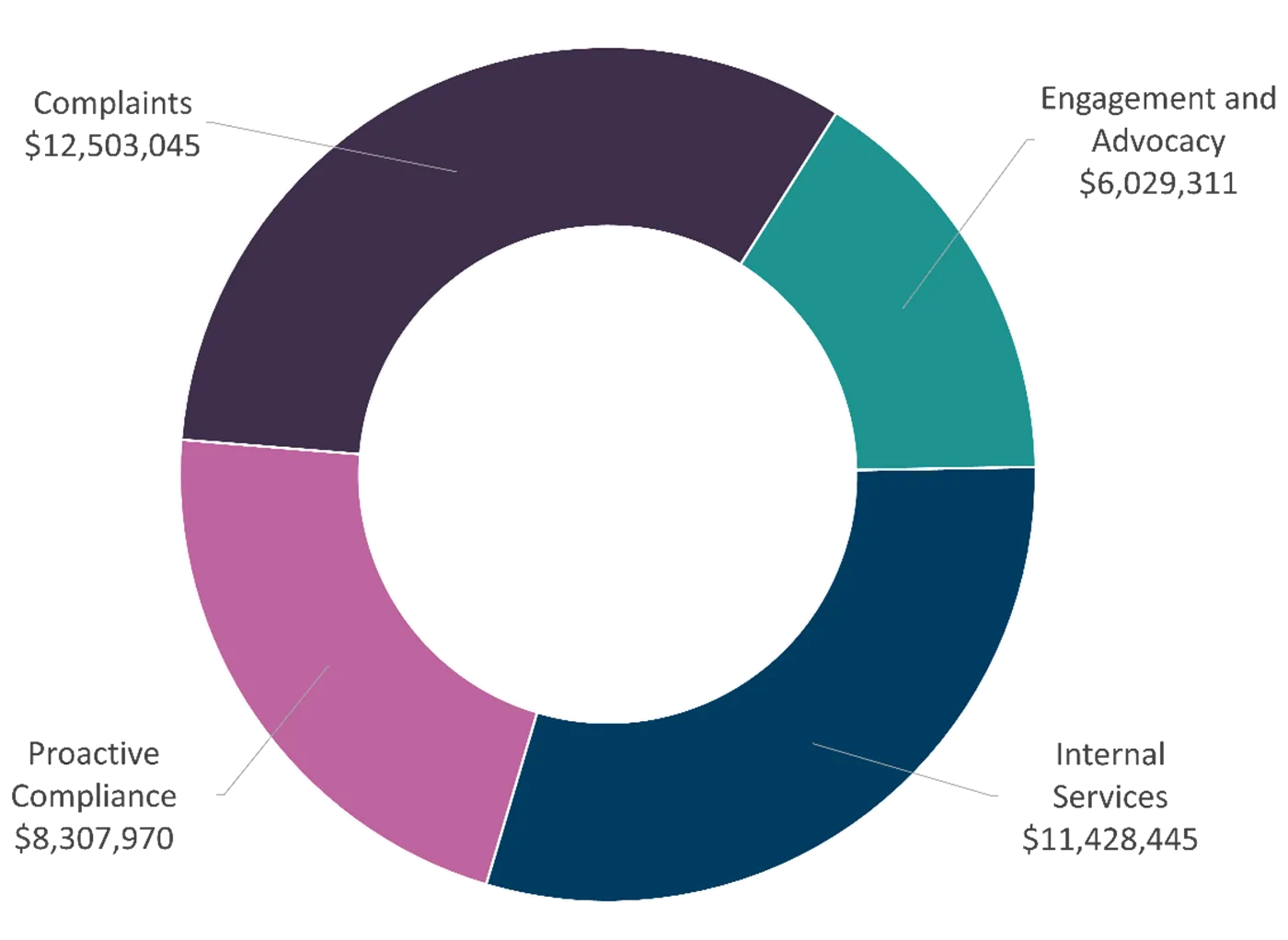
Graph 1 presents the department's planned spending in 2026–2027 by core responsibility and for internal services.
| Core responsibilities and internal services | 2026–2027 Planned spending |
|---|---|
| Engagement and Advocacy | $6,029,311 |
| Complaints | $12,503,045 |
| Proactive Compliance | $8,307,970 |
| Internal services | $11,428,445 |
The Commission has reduced its overall planned spending in 2026–2027 due to lower budgetary authorities compared with 2025–2026. These reductions come from the Comprehensive Expenditure Review, sunsetting funding to support the Federal Housing Advocate and sunsetting funding to support the National Monitoring Mechanism.
Table 14 presents the Commission's spending over the past three years to carry out its core responsibilities and for internal services. Amounts for the 2025–2026 fiscal year are forecasted based on spending to date.
| Core responsibilities and internal services | 2023–2024 Actual Expenditures | 2024–2025 Actual Expenditures | 2025–2026 Forecast Spending |
|---|---|---|---|
| Engagement and Advocacy | $7,373,685 | $6,510,598 | $6,115,693 |
| Complaints | $13,706,079 | $13,582,070 | $14,046,858 |
| Proactive Compliance | $8,627,465 | $8,392,074 | $7,857,267 |
| Subtotal (s) | $29,707,229 | $28,484,742 | $28,019,818 |
| Internal services | $15,171,244 | $13,079,349 | $12,867,513 |
| Total (s) | $44,878,473 | $41,564,092 | $40,887,331 |
Spending in 2023–2024 was higher than in 2024–2025 and 2025–2026 primarily due to the signing of new collective bargaining agreements with a significant number of employment groups. The signing of these new collective agreements required one-time retroactive salary payments, which led to an increase in authorities and expenditures of $3.4 million in 2023–2024.
More financial information from previous years is available on the Finances section of GC Infobase.
Table 15 presents the Commission's planned spending over the next three years by core responsibilities and for internal services.
| Core responsibilities and internal services | 2026–2027 Planned Spending | 2027–2028 Planned Spending | 2028–2029 Planned Spending |
|---|---|---|---|
| Engagement and Advocacy | $6,029,311 | $5,936,246 | $5,723,508 |
| Complaints | $12,503,045 | $12,298,164 | $11,835,029 |
| Proactive Compliance | $8,307,970 | $8,173,070 | $7,867,616 |
| Subtotal | $26,840,326 | $26,407,480 | $25,426,153 |
| Internal services | $11,428,445 | $11,183,494 | $10,636,410 |
| Total | $38,268,771 | $37,590,974 | $36,062,563 |
The Commission's planned spending steadily decreases over the next three years mainly due to the CER Reductions that are being implemented. One of the Commission's CER proposals is still pending final approval therefore the assumption included in the table is that it will proportionately affect all four core responsibilities of the Commission.
More detailed financial information on planned spending is available on the Finances section of GC Infobase.
Table 16 reconciles gross planned spending with net spending for 2026–2027.
| Core responsibilities and Internal services | 2026–2027 Gross planned spending (dollars) | 2026–2027 Planned revenues netted against spending (dollars) | 2026–2027 Planned net spending (authorities used) |
|---|---|---|---|
| Engagement and Advocacy | $6,029,311 | $0 | $6,029,311 |
| Complaints | $12,503,045 | $0 | $12,503,045 |
| Proactive Compliance | $8,307,970 | $0 | $8,307,970 |
| Subtotal | $26,840,326 | $0 | $26,840,326 |
| Internal services | $13,967,012 | -$2,538,567 | $11,428,445 |
| Total | $40,807,338 | -$2,538,567 | $38,268,771 |
The Commission provides internal support services to other small government departments and agencies such as finance, human resources, acquisition and information technology services. These Internal Support Services agreements are recorded as revenues as per section 29.2 of the Financial Administration Act.
Information on the alignment of the Commission's spending with Government of Canada's spending and activities is available on GC InfoBase.
This section provides an overview of the department's voted and statutory funding for its core responsibilities and for internal services. For further information on funding authorities, consult the Government of Canada budgets and expenditures.
Graph 2 summarizes the department's approved voted and statutory funding from 2023–2024 to 2028–2029.
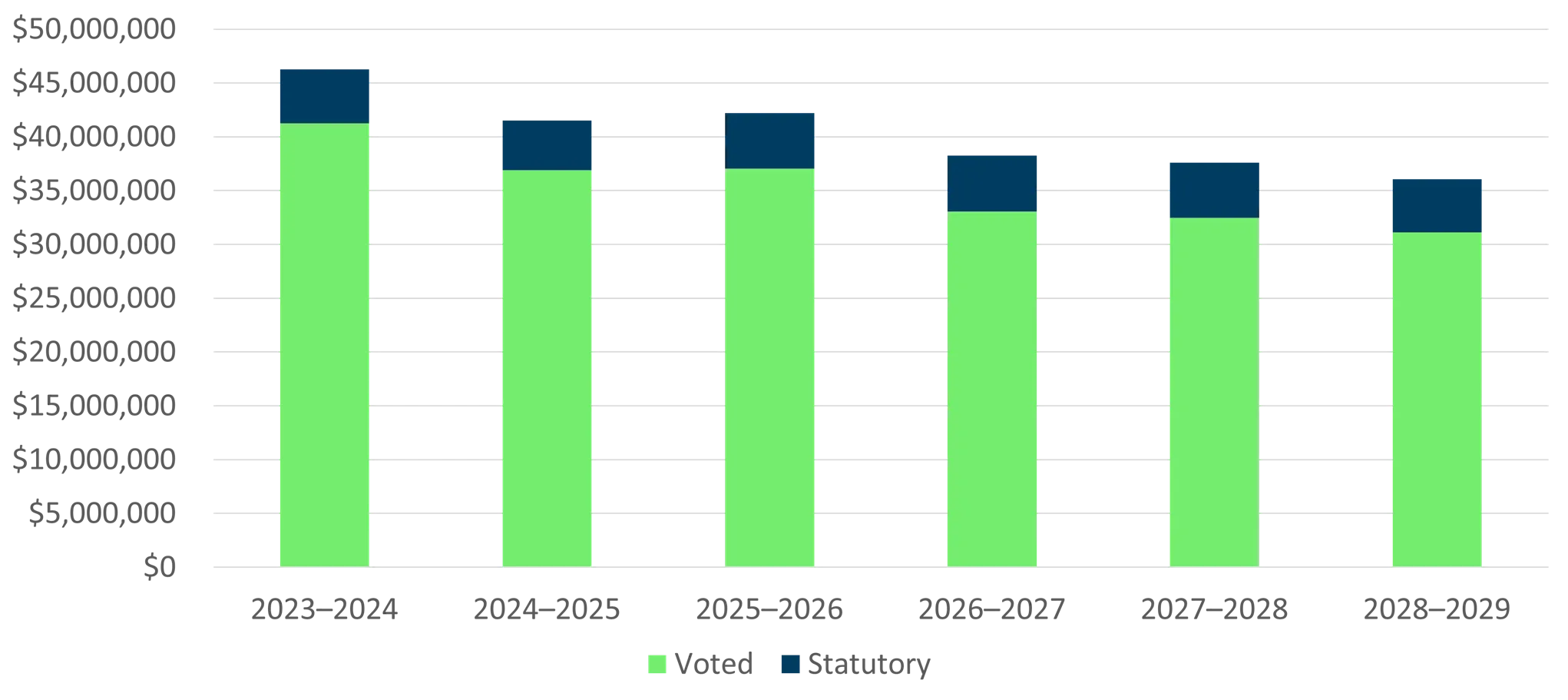
| Fiscal year | Total | Voted | Statutory |
|---|---|---|---|
| 2023–2024 | $46,252,108 | $41,270,000 | $4,982,108 |
| 2024–2025 | $41,499,213 | $36,896,644 | $4,602,569 |
| 2025–2026 | $42,220,145 | $37,050,691 | $5,169,454 |
| 2026–2027 | $38,268,771 | $33,077,305 | $5,191,466 |
| 2027–2028 | $37,590,974 | $32,473,682 | $5,117,292 |
| 2028–2029 | $36,062,563 | $31,117,437 | $4,945,126 |
The Commission's authorities increased in 2023–2024 due to a one-time payment of $3.4 million in salary adjustments related to new collective bargaining agreements and a maximized operating budget carryforward which declined by $845 thousand in 2024–2025. Authorities decrease starting in 2026–2027 due to the sunsetting of funds for the National Monitoring Mechanism and the sunsetting of funds to support the Federal Housing Advocate. Also starting in 2026–2027, gradual reductions in funding due to the CER exercise.
For further information on the Commission's departmental appropriations, consult the 2026–2027 Main Estimates.
The future-oriented condensed statement of operations provides an overview of the Commission's for 2025–2026 to 2026–2027.
Table 17 summarizes the expenses and revenues which net to the cost of operations before government funding and transfers for 2025–2026 to 2026–2027. The forecast and planned amounts in this statement of operations were prepared on an accrual basis. The forecast and planned amounts presented in other sections of the Departmental Plan were prepared on an expenditure basis. Amounts may therefore differ.
| Financial information | 2025–2026 Forecast results | 2026–2027 Planned results | Difference (planned results minus forecasted) |
|---|---|---|---|
| Total expenses | $48,720,519 | $47,643,733 | -$1,076,786 |
| Total revenues | -$2,439,361 | -$2,538,567 | -$99,206 |
| Net cost of operations before government funding and transfers | $46,281,158 | $45,105,166 | -$1,175,992 |
The decrease in forecast results in 2025-2026 and planned results 2026-2027 is mainly due to CER reductions, sunsetting funding to support the Federal Housing Advocate and sunsetting funding to support the National Monitoring Mechanism.
A more detailed Future-Oriented Statement of Operations and associated Notes for 2026–2027, including a reconciliation of the net cost of operations with the requested authorities, is available on the Commission's website.
This section presents an overview of the department's actual and planned human resources from 2023–2024 to 2028–2029.
Table 18 shows a summary of human resources, in full-time equivalents, for the Commission's core responsibilities and for its internal services for the previous three fiscal years. Human resources for the 2025–2026 fiscal year are forecasted based on year to date.
| Core responsibilities and Internal Services | 2023–2024 Actual full-time equivalents | 2024–2025 Actual full-time equivalents | 2025–2026 Forecasted full-time equivalents |
|---|---|---|---|
| Engagement and Advocacy | 40 | 38 | 36 |
| Complaints | 97 | 91 | 96 |
| Proactive Compliance | 56 | 54 | 50 |
| Subtotal | 193 | 183 | 182 |
| Internal services | 107 | 100 | 100 |
| Total | 300 | 283 | 282 |
Note: FTEs under Internal Services for 2023–2024 include 19 FTEs for internal support services that the Commission offers to other small government departments. The Commission reported higher FTEs in 2023–2024 due to higher temporary funding available in that fiscal year. FTEs have since declined to reflect the Commission's available authorities.
In 2024–2025, increased budgetary uncertainty prompted the Commission to take a more cautious approach to staffing. This, combined with a higher number of employees on secondment and parental leave, resulted in a significant decrease in FTEs.
Table 19 shows information on human resources, in full-time equivalents, for each of the Commission's core responsibilities and for its internal services planned for the next three years.
| Core responsibilities and internal services | 2026–2027 Planned full-time equivalents | 2027–2028 Planned full-time equivalents | 2028–2029 Planned full-time equivalents |
|---|---|---|---|
| Engagement and Advocacy | 35 | 35 | 33 |
| Complaints | 85 | 84 | 82 |
| Proactive Compliance | 53 | 52 | 50 |
| Subtotal | 173 | 171 | 165 |
| Internal services | 94 | 92 | 89 |
| Total | 267 | 263 | 254 |
Planned FTEs are projected to decrease over the next three years due to the implementation of the CER reductions. Figures in the table are based on an assumption of even distribution across all core responsibilities since decisions on the Commission's proposal is still pending.
Information on the Commission's Departmental Sustainable Development Strategy can be found on the Commission's website.
The Commission's Departmental Plan does not include information on tax expenditures.
The tax system can be used to achieve public policy objectives through the application of special measures such as low tax rates, exemptions, deductions, deferrals and credits. The Department of Finance Canada publishes cost estimates and projections for these measures each year in the Report on Federal Tax Expenditures.
This report also provides detailed background information on tax expenditures, including descriptions, objectives, historical information and references to related federal spending programs as well as evaluations and GBA Plus of tax expenditures.
The Honourable Sean Fraser, P.C., M.P.
(Interim Chief Commissioner) Deputy Chief Commissioner Charlotte-Anne Malischewski
Justice
Jobs and Families
Housing and Infrastructure
Canadian Human Rights Commission
344 Slater Street, 8th Floor
Ottawa, Ontario K1A 1E1
613-995-1151
1-888-214-1090
1-888-643-3304
613-996-9661
Website: http://www.chrc-ccdp.gc.ca
X (formerly Twitter): @CdnHumanRights
Facebook: https://www.facebook.com/CanadianHumanRightsCommission
Bluesky: @CdnHumanRights.bsky.social
Is an analytical tool used to support the development of responsive and inclusive policies, programs, and other initiatives. GBA Plus is a process for understanding who is impacted by the issue or opportunity being addressed by the initiative; identifying how the initiative could be tailored to meet diverse needs of the people most impacted; and anticipating and mitigating any barriers to accessing or benefitting from the initiative. GBA Plus is an intersectional analysis that goes beyond biological (sex) and socio-cultural (gender) differences to consider other factors, such as age, disability, education, ethnicity, economic status, geography (including rurality), language, race, religion, and sexual orientation.
Using GBA Plus involves taking a gender- and diversity-sensitive approach to our work. Considering all intersecting identity factors as part of GBA Plus, not only sex and gender, is a Government of Canada commitment.
For Departmental Plans and Departmental Results Reports, planned spending refers to those amounts presented in Main Estimates.
A department is expected to be aware of the authorities that it has sought and received. The determination of planned spending is a departmental responsibility, and departments must be able to defend the expenditure and accrual numbers presented in their Departmental Plans and Departmental Results Reports.