To view the full version and footnotes, please consult the PDF copy.
Introduction
The Canadian Human Rights Commission (CHRC) and the Office of the Federal Housing Advocate (OFHA) have legislated mandates to monitor human rights. Together, we are establishing a framework to monitor the right to adequate housing for people with disabilities in Canada. This framework helps to assess whether Canada is meeting its human rights obligations under Canadian and international laws, including the United Nations Convention on the Rights of Persons with Disabilities (CRPD) and the International Covenant on Economic, Social and Cultural Rights (ICESCR). Our work is designed to assist the Government of Canada in fulfilling its responsibility to monitor and report on its human rights obligations.
This monitoring framework tracks housing outcomes, policy efforts and government resources (i.e., spending) in the following eleven areas: institutionalization; homelessness; accessibility; the availability of supports and services; discrimination and dignity; affordability; security of tenure; safety; habitability; location; and cultural adequacy. You can find the indicators for all eleven areas on our website. This report presents the results for the outcome indicators on institutionalization. Institutionalization indicators help monitor how many people with disabilities live in collective dwellings, such as nursing homes, residences for seniors, and residential care facilities including group homes for people with disabilities or addictions. These indicators are essential for assessing progress toward the right to live independently and be included in the community, as outlined in Article 19 of the CRPD. Article 19 affirms that people with disabilities must have real choice in where and with whom they live, access to the supports they need to live independently, and equal access to community services and facilities.
We are creating a baseline of results that can be updated as new data becomes available and to help measure progress. We use a variety of data sources to track outcomes, since no single source captures the lived experiences of all people with disabilities in Canada. We also recognize that there are gaps in the data being collected at the time of writing this report.1 We primarily drew on data from the Canadian Survey on Disability (CSD) from 2017 and 2022 and the Canadian Housing Survey (CHS) from 2021. These two surveys use the social model of disability to identify people with disabilities. For these indicators, we also relied on the Canadian Income Survey (CIS) from 2019. The CSD and the CIS identify people with disabilities in different ways. Because their populations, sampling frames, and disability measures differ, results from these two surveys should not be directly compared. We also incorporated data from the Census of Collective Dwellings (CCD), which collects information on all residents living in long-term care homes. This data was most
recently collected in 2016 and 2021, providing insight into institutional living environments that are not captured in household surveys. We disaggregated data to the greatest extent possible, applying an intersectional approach, but due to data gaps we were unable to disaggregate fully. Notable results for particular intersections of identities were included when the data was available.
What people told us
Many people with disabilities told us they are forced to live in institutions because there are no supports available in the community. They said people who are institutionalized don't get to make decisions about their daily lives, such as choosing who to live with, and what and when to eat. They told us that people with disabilities who have complex care needs should not be “warehoused” in nursing homes and other institutions. They also said very little data is collected about people who live in institutions.
- “I have a disability. I live in a bachelor apartment in a seniors' residence. I am not a senior, but they put me here. I have had issues with the staff, including harassment, poor communication, violence and just plain ignorance when it comes to dealing with my issues.”
- “The state of long-term care in Canada scares the life out of me. I would likely consider medical assistance in dying (MAiD) before entering a long-term care facility in the future.”
Analysis
Indicator 1: Number of people living in large institutions for people with disabilities
- This data is not currently collected through national or provincial / territorial surveys. We are advocating for better data collection and transparency in this area.
Indicator 2: Number of people with disabilities under age 55 in long-term care
- The number of people with disabilities under age 55 living in long-term care homes increased, from 7,505 in 2016 to 7,590 in 2021 (see figure 1).
- People under age 55 make up the majority of residents in residential care facilities. In 2021, 55.4% of people living in residential care facilities were under age 55. These facilities housed 34,200 people aged 0-54 and 27,505 people aged 55 and older (see figure 2).
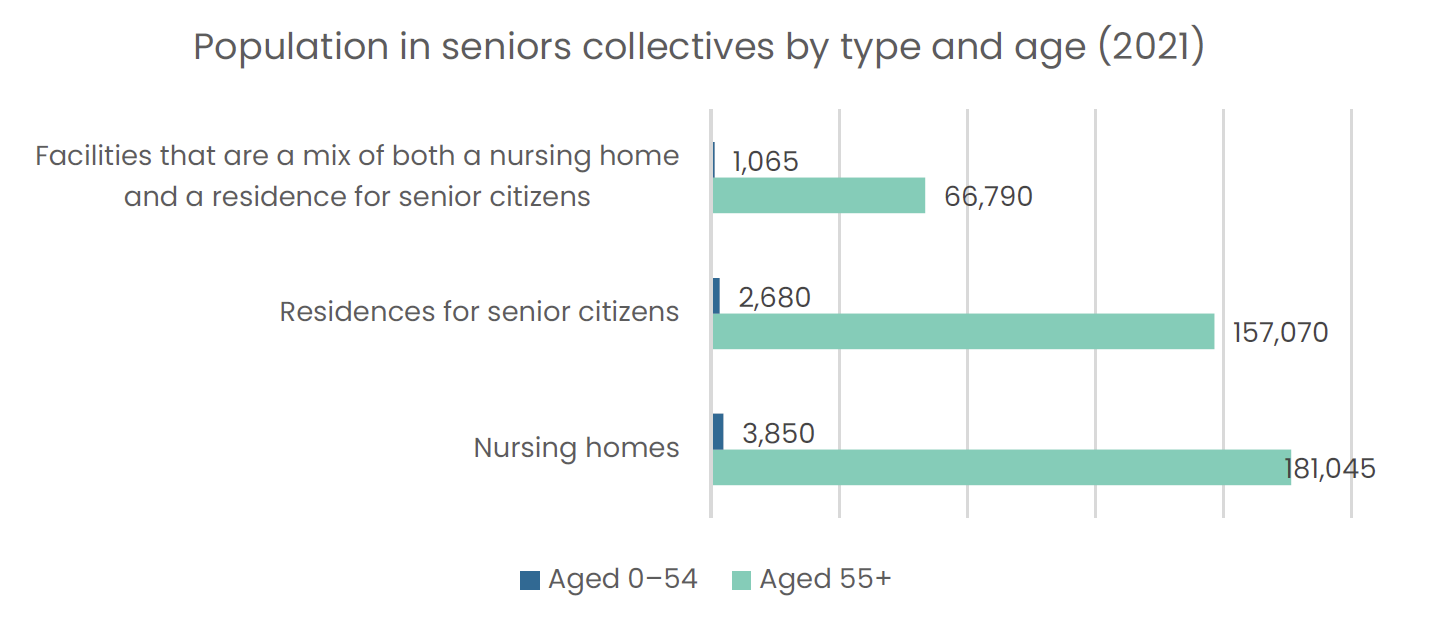
Figure 1 - text version
| Aged 0–54 | Aged 55+ | |
|---|---|---|
| Facilities that are a mix of both a nursing home and a residence for senior citizens | 1,065 | 66,790 |
| Residences for senior citizens | 2,680 | 157,070 |
| Nursing homes | 3,850 | 181,045 |
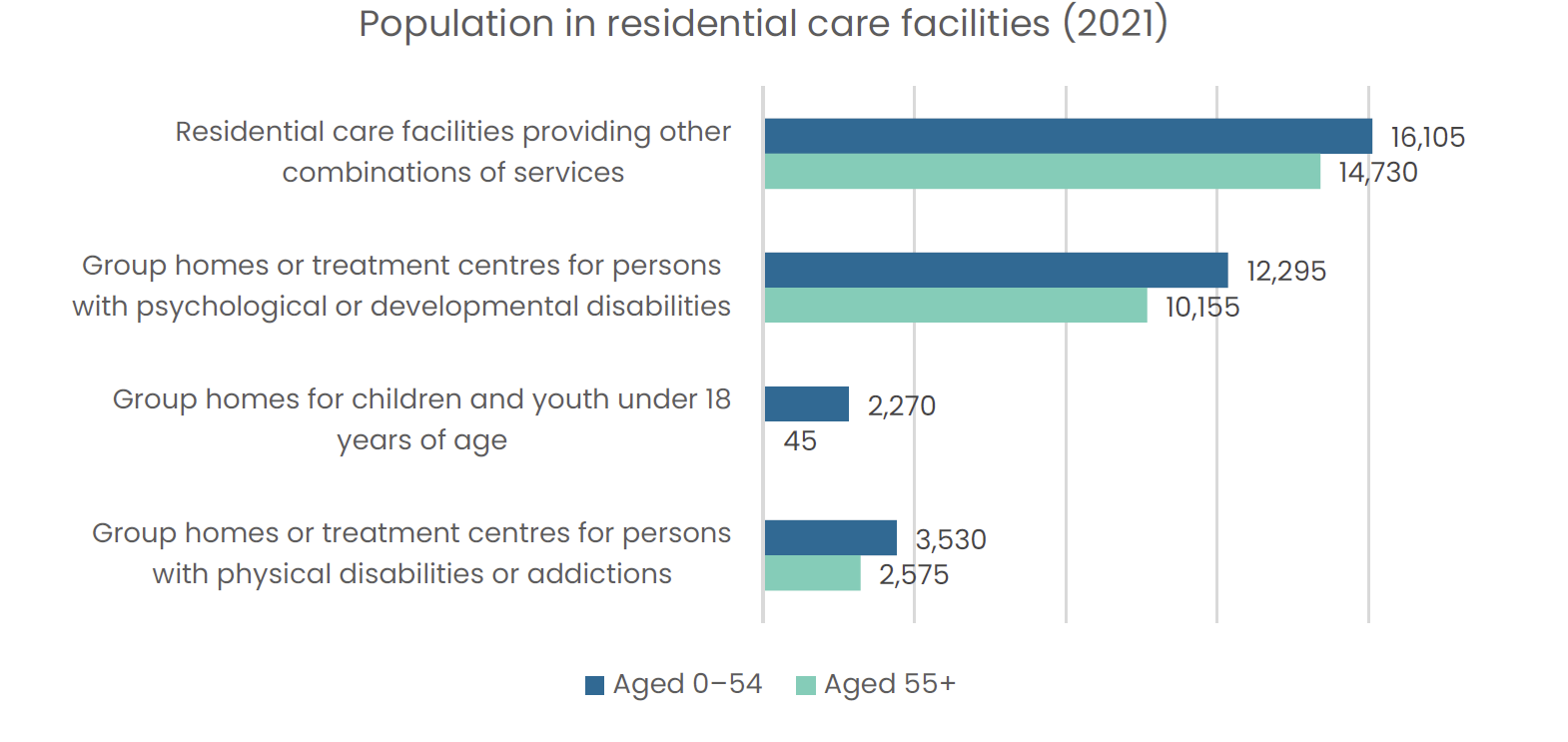
Figure 2 - text version
| Aged 0–54 | Aged 55+ | |
|---|---|---|
| Residential care facilities providing other combinations of services | 16,105 | 14,730 |
| Group homes or treatment centres for persons with psychological or developmental disabilities | 12,295 | 10,155 |
| Group homes for children and youth under 18 years of age | 2,270 | 45 |
| Group homes or treatment centres for persons with physical disabilities or addictions | 3,530 | 2,575 |
Indicator 3: Number of people with disabilities in group homes and other group living situations
- The number of people with disabilities living in residential care facilities like group homes for people with disabilities and addictions decreased from 65,790 people in 2016 to 61,710 in 2021.
- Men are overrepresented across all types of residential care facilities. In 2021, there were 4,005 men compared to 2,100 women in group homes or treatment centers for persons with physical disabilities or addictions; 1,340 men compared to 980 women in group homes for children and youth under 18 years of age7; 13,265 men and 9,180 women in group homes or treatment centers for persons with psychological or developmental disabilities; and 18,985 men and 11,850 women in residential care facilities providing other combinations of services (see figure 3 and 4).8 In addition to this overall overrepresentation, men are also disproportionately represented at younger ages (0–54) across all facility types, suggesting earlier entry into residential care.
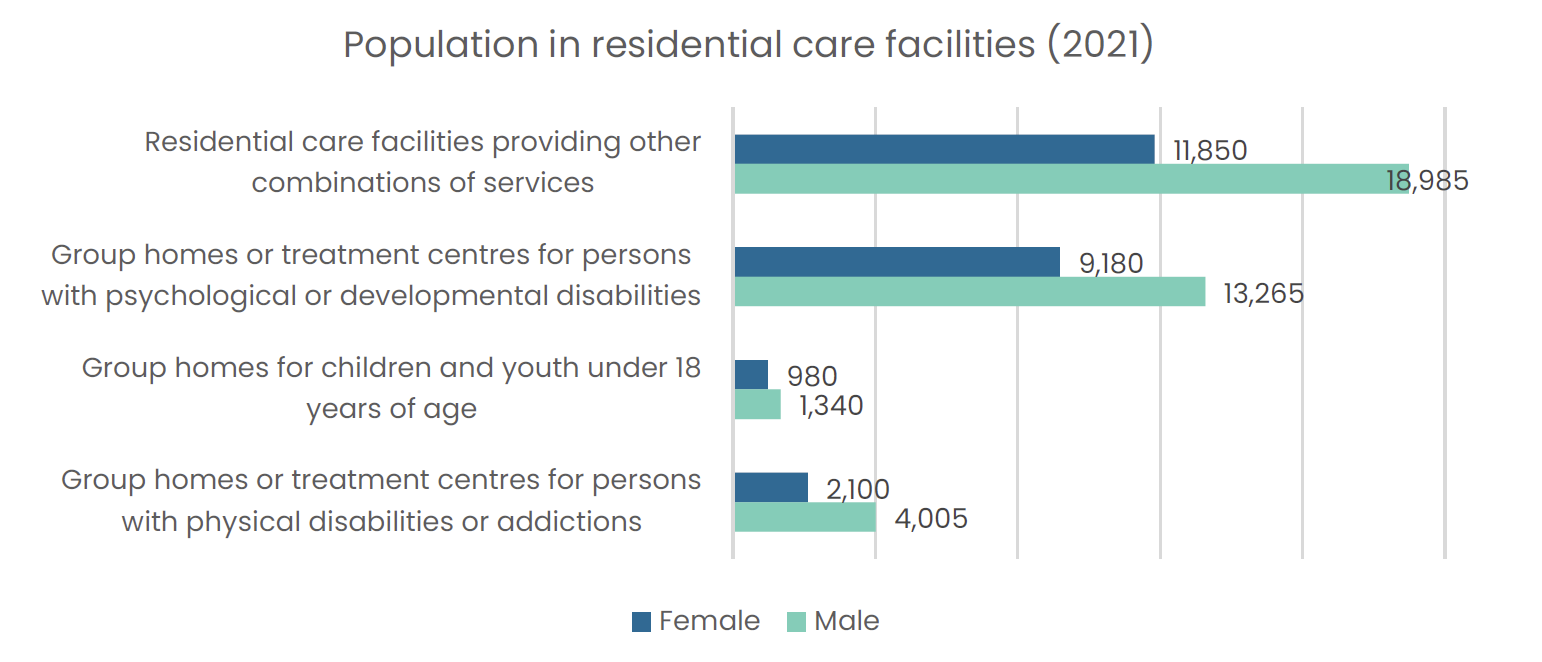
Figure 3 - text version
| Female | Male | |
|---|---|---|
| Residential care facilities providing other combinations of services | 11,850 | 18,985 |
| Group homes or treatment centres for persons with psychological or developmental disabilities | 9,180 | 13,265 |
| Group homes for children and youth under 18 years of age | 980 | 1,340 |
| Group homes or treatment centres for persons with physical disabilities or addictions | 2,100 | 4,005 |
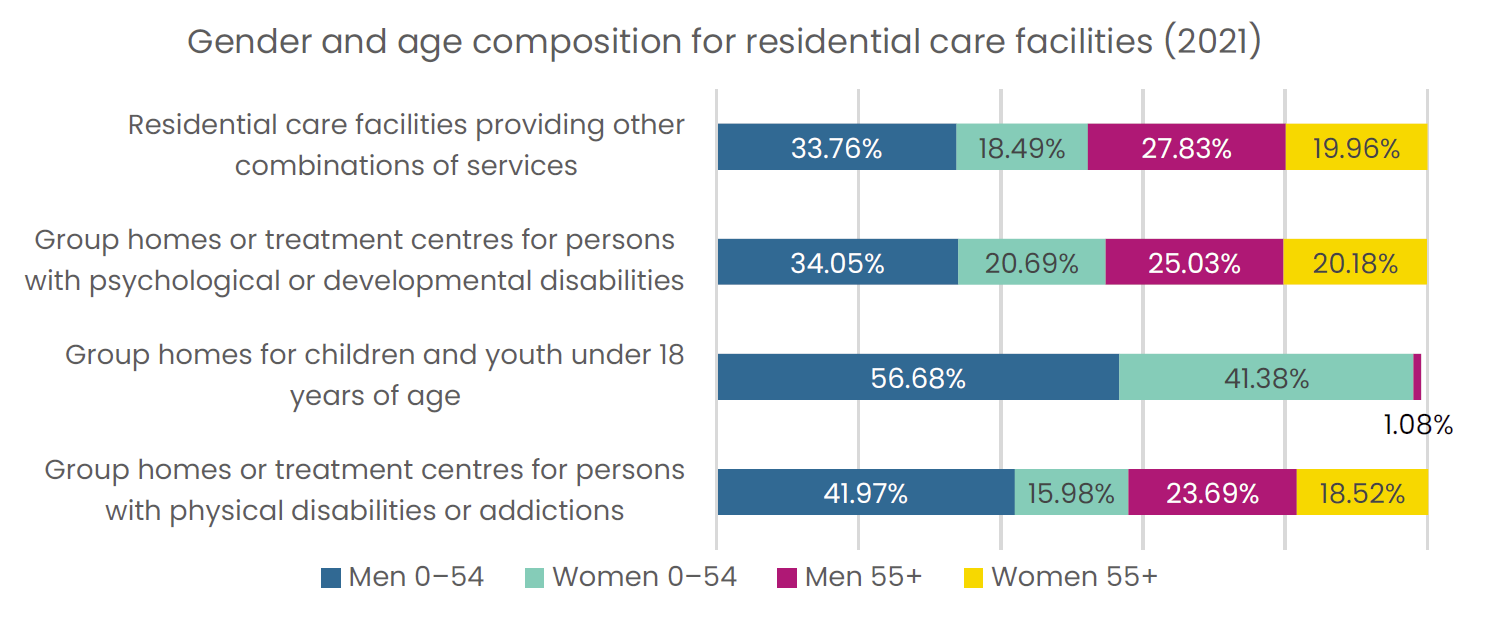
Figure 4 - text version
| Men 0–54 | Women 0–54 | Men 55+ | Women 55+ | |
|---|---|---|---|---|
| Residential care facilities providing other combinations of services | 33.76% | 18.49% | 27.83% | 19.96% |
| Group homes or treatment centres for persons with psychological or developmental disabilities | 34.05% | 20.69% | 25.03% | 20.18% |
| Group homes for children and youth under 18 years of age | 56.68% | 41.38% | 1.08% | 0% |
| Group homes or treatment centres for persons with physical disabilities or addictions | 41.97% | 15.98% | 23.69% | 18.52% |
Indicator 4: Percentage of people with disabilities in prisons and correctional facilities
- Results: Not available. This data is not currently collected through national or provincial / territorial surveys. We are advocating for better data collection and transparency in this area.
Indicator 5: Percentage of people with disabilities in immigration detention centres and shelters for refugees and asylum seekers
- Results: Not available. This data is not currently collected through national or provincial / territorial surveys. We are advocating for better data collection and transparency in this area.
Indicator 6: Percentage of people with disabilities in homeless shelters
- Results: Not available. This data is not currently collected through national or provincial / territorial surveys. We are advocating for better data collection and transparency in this area.
Indicator 7: Number of people with disabilities detained in hospitals
- Results: Not available. This data is not currently collected through national or provincial / territorial surveys. We are advocating for better data collection and transparency in this area.
Indicator 8: Percentage of people with disabilities in child welfare systems
- Results: Not available. This data is not currently collected through national or provincial / territorial surveys. We are advocating for better data collection and transparency in this area.
Indicator 9: Percentage of people with disabilities who are satisfied with their level of autonomy over their living arrangements
- Results: Not available. This data is not currently collected through national or provincial / territorial surveys. We are advocating for better data collection and transparency in this area.
Conclusion
In conclusion, the findings highlight the urgent need for a more inclusive and accessible housing framework that allows people with disabilities to live independently and be integrated into their communities, as envisioned by Article 19 of the United Nations Convention on the Rights of Persons with Disabilities. The results based on the available data reveal critical gaps in data collection and transparency concerning the living arrangements and institutional experiences of people with disabilities in Canada. While some insights have been drawn, such as the overrepresentation of young adults in long-term care and gender disparities in residential care facilities, the lack of comprehensive data across numerous indicators remains a significant
barrier to fully understanding and addressing the needs of people with disabilities.
Read our report with recommendations to address these issues.