 Section 01: Introduction
Pay Equity Commissioner's message
It is with great honour that I present my 2025-2026 Annual Report, entitled: Advancing pay equity through accountability and action.
In periods of economic uncertainty and social strain, we have an opportunity to reimagine the systems that led us to this point. An opportunity to advance economic prosperity by continuing to push forward with advancing fundamental rights. For me as Pay Equity Commissioner, this means not losing sight of the gains that flow from paying women fairly.
Equal pay for work of equal value is a fundamental human right and closing the wage gap benefits everyone. When workplaces are diverse and inclusive, they foster broader perspectives, stronger decision-making, and greater economic growth. Across Canada, women's participation in the workforce is strong, and it continues to grow. This progress presents an important opportunity to ensure women are recognized and compensated fairly for the value of their work.
As we move through another year shaped by economic pressures and rising cost of living, there is both reason for optimism and a need for action. While women continue to make significant contributions across every sector of the economy, many still face barriers in areas like equitable pay, housing stability, economic security, and opportunity. Women experience disproportionate levels of housing insecurity, while persistent wage gaps continue to affect their financial well-being and long-term stability. These challenges are even more pronounced for Indigenous, Black, and other racialized women, women with disabilities, older women and trans women.
At the same time, growing awareness of these disparities has strengthened momentum for meaningful change. Advancing pay equity and addressing systemic barriers are not only matter of fairness. They are investments in a more inclusive, productive and prosperous Canada where everyone has the opportunity to thrive. But participation gains and awareness alone will not close this gap. Systemic inequities require systemic solutions.
Canada's Pay Equity Act is one such solution. By placing responsibility on federally regulated employers to assess compensation practices, identify inequities, and take corrective action, the Pay Equity Act affirms that wage equality is not optional, it is an obligation grounded in human rights and economic fairness.
Over the past year, we listened carefully to employers, workers and stakeholders. We heard concerns about lengthy processing times and the complexity of new obligations. We also heard a need for more practical guidance and further clarity in our decision-making process.
In response, we have taken concrete steps to strengthen how we deliver this program. Over the past year, we have optimized internal processes to streamline dispute resolution and clarify adjudicative pathways. We have updated and expanded guidance tools, enhanced the functionality of our online portal, and continued to deliver workshops and refreshed online learning resources. We have engaged with more than 360 stakeholders and strengthened collaboration with provincial partners, while participating in targeted outreach initiatives.
This year has also produced important institutional insights. Annual Statements submitted by employers are beginning to generate meaningful data, allowing us to identify emerging trends and better understand how pay equity is being operationalized across sectors. Decisions issued under the Act continue to build jurisprudence, establishing precedents that provide consistent and predictable interpretations and applications.
At the same time, our focus on compliance has sharpened. We are strengthening evidence-based compliance activities based on data from employer self-reporting. Our renewed approach to dispute resolution is designed to be faster, more transparent, and more predictable.
Achieving the pay equity vision requires sustained action and continued leadership. Important progress is underway, and the growing number of organizations taking concrete steps toward compliance is encouraging, but there is still more work to do to ensure these efforts translate into meaningful change. Canada has an opportunity to continue leading in this space, and by maintaining that momentum, we can help ensure the benefits of a stronger and more equitable economy are shared more broadly.
This work is vital to the historic moment Canada is in right now. As Canada charts the course ahead, we must ensure that human rights are at the centre – including the fundamental human right for women in all their diversity to equal pay for work of equal value. Canada is stronger when every person has a chance to thrive and to fully participate in our society and economy, without barriers.
Sincerely,
Lori Straznicky
Federal Pay Equity Commissioner
 Section 02: Pay equity in Canada by the numbers
Pay Equity 2025-2026: By the numbers
Statistics Canada's Quality of Employment data shows long-term improvements between 2006 and 2024. Although the gap between men and women is slowly closing with women's average hourly wages growing faster (+21.3%) than men's (+15.9%) over this period, more must be done to narrow it further and ultimately eliminate it completely. The data also demonstrate how the wage gap varies significantly by age:

15–24
5.9% gap in 2024
(down from 9.2% in 2006)
25–54
12.2% gap in 2024
(down from 16.4% in 2006)
55+
16.6% gap in 2024
(down from 20.7% in 2006)
Formal disputes
Text version of Formal disputes
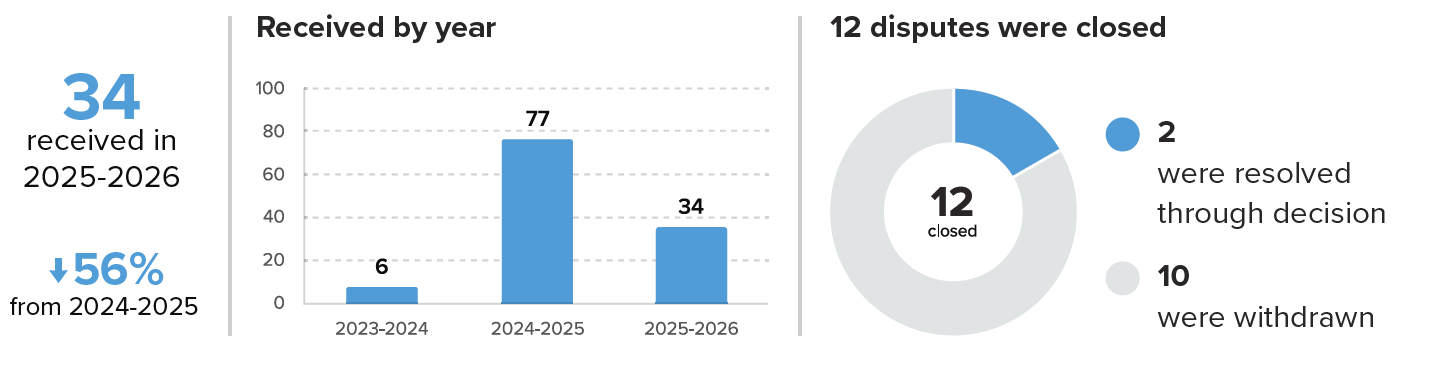
34 received in 2025-2026
Less than 56% from 2024-2025
| 2023-2024 | 2024-2025 | 2025-2026 |
|---|---|---|
| 6 | 77 | 34 |
12 disputes were closed:
- 2 were resolved through decision
- 10 were withdrawn
Authorization requests
Text version of Authorization requests
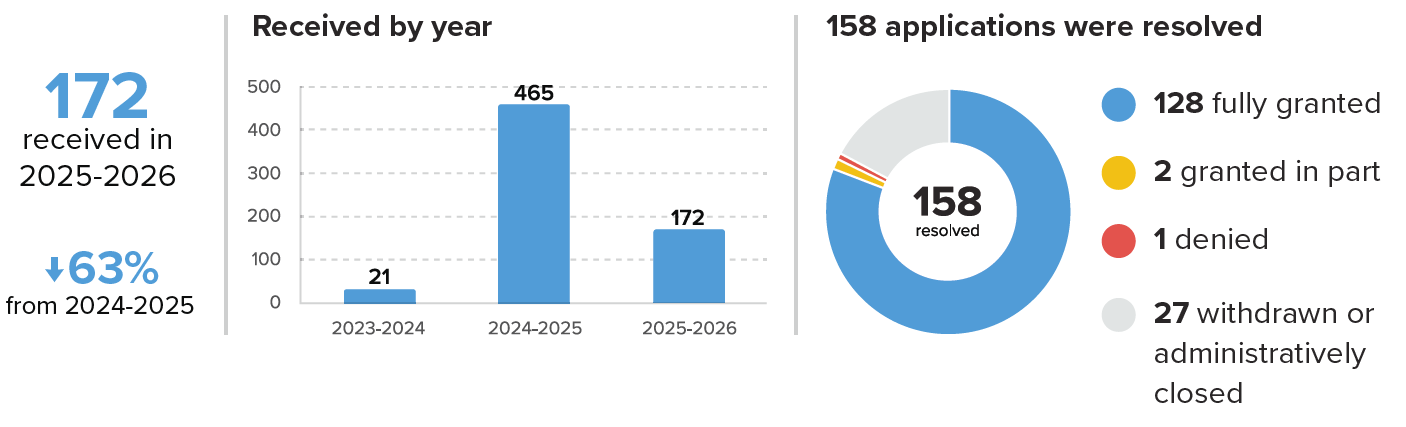
172 received in 2025-2026
Less than 63% from 2024-2025
| 2023-2024 | 2024-2025 | 2025-2026 |
|---|---|---|
| 21 | 465 | 172 |
158 applications were resolved:
- 128 fully granted
- 2 granted in part
- 1 denied
- 27 withdrawn or administratively closed
Requests for information
Text version of Requests for information
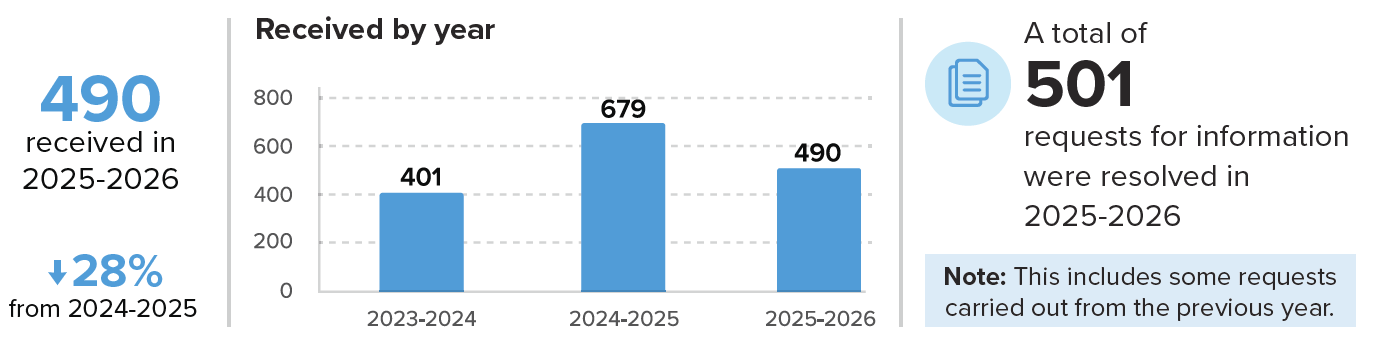
490 received in 2025-2026
Less than 28% from 2024-2025
| 2023-2024 | 2024-2025 | 2025-2026 |
|---|---|---|
| 401 | 679 | 490 |
A total of 501 requests for information were resolved in 2025-2026
Annual Statements
Text version of Annual Statements
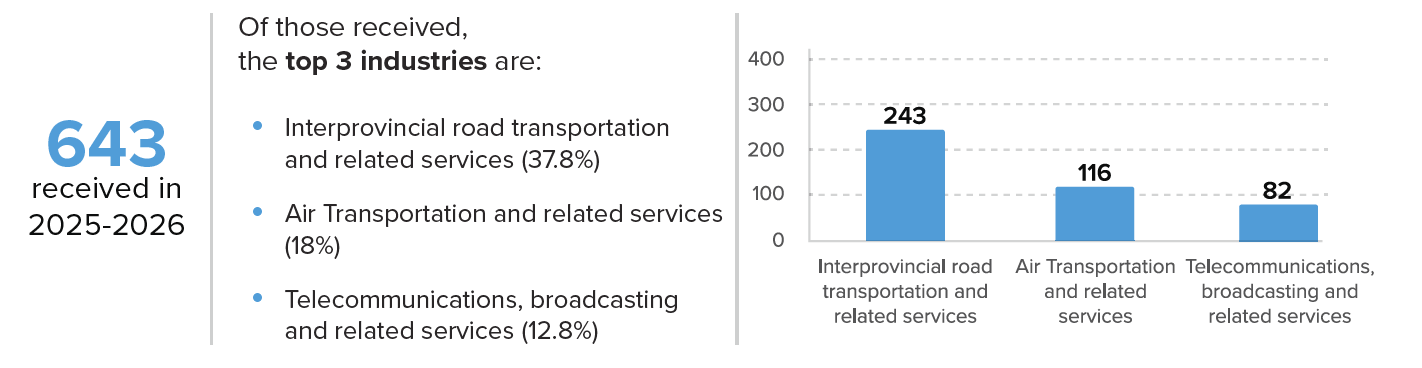
643 received in 2025-2026
Of those received, the top 3 industries are:
- Interprovincial road transportation and related services (37.8%)
- Air Transportation and related services (18%)
- Telecommunications, broadcasting and related services (12.8%)
| Interprovincial road transportation and related services | Air Transportation and related services | Telecommunications, broadcasting and related services |
|---|---|---|
| 243 | 116 | 82 |
 Section 03: Monitoring and promoting compliance
Timeline of progress
In 2025-2026 the Pay Equity Commissioner continued focusing on compliance promotion. This year, most employers subject to the Pay Equity Act were required to start their maintenance review process, as is required within five years of posting their first pay equity plan. Employers also submitted their first annual statement.
Pay equity maintenance reviews are conducted by employers in accordance with the Act to ensure that compensation remains equitable over time. Through periodic self-assessment, these reviews are an opportunity for employers to identify and address any changes that may affect pay equity and include employee input. Where required, compensation adjustments are implemented to correct identified gaps and maintain compliance.
The Pay Equity Commissioner issued updates and reminders to employers via newsletters and communicated with employers via the Pay Equity Portal. Through updated tools, resources and jurisprudence, the Commissioner continued to offer support to workplace parties as they fulfilled their obligations.
Most employers were required to submit their first annual statement by June 30, 2025. To further support compliance, the Pay Equity Commissioner helped employers to do so through the Annual Statement Portal. This portal is a centralized, digital platform designed to help employers and workplace parties complete and submit their annual statements more efficiently. The Portal was developed to reduce administrative burden by guiding users through the reporting process in a clear and accessible way, while also creating a reliable source of data to support compliance monitoring, education and enforcement activities.
Annual statements
To date, the Pay Equity Commissioner received 643 annual statements representing about 12% of all employers. Of these, 21.2% were employers with more than 500 employees, 23% had a workforce of 100 to 499 employees, and 12.8% had fewer than 100 employees. Compliance rates varied across sectors, with the highest rates observed in road transportation (37.8%) and air transportation (18%) followed by 12.8% in telecommunications, broadcasting and related services (12.8%). Non-unionized employers reported considerably higher compliance rates than unionized employers, particularly in the air transportation sector, where non-unionized compliance was approximately four times that of the unionized employers (29.6% compared to 7.2%).
Among the 643 employers who submitted their annual statements, 129 (approximately 20%) reported owing an increase to their female employees. The average hourly wage increase owed to female-predominant job classes was $2.37. Medium and large-sized employers reported mostly below-average hourly increases across many job classes (ranging from $1.99 to $2.42 respectively) while smaller-sized employers reported mostly above-average hourly pay increases of $2.69. In the banking sector, medium and large sized non-unionized employers are reporting pay equity adjustment gaps of more than 30%. Similarly, in road transportation, small non-unionized employers reported a gap of about 25% in their pay equity adjustment.
Authorization requests
The Pay Equity Act lays out the rules all employers must follow. However, there may be certain situations when an employer or pay equity committee needs to ask the Pay Equity Commissioner for permission to change the way certain rules apply to them.
With the passing of the legislated deadline in 2024-2025, authorization requests declined to 172 new applications, compared to the over twentyfold increase previously observed between 2023-2024 and 2024-2025, when authorization requests went from 21 to 465. Similarly, requests for information also decreased significantly in 2025-2026, following the same trend as authorization requests.
Some employers continued to request flexibility in their posting date, with 94% of authorization applications seeking an extension. This year, the Pay Equity Commissioner granted 158 applications fully, two in part, and denied one, while 27 applications were withdrawn or closed administratively.
Requests for information
In 2025-2026, the Pay Equity Commissioner received a total of 490 requests for information, down from 679 in the previous fiscal year. Most requests continued to come from employers (66.5%), suggesting that regulated entities are proactively seeking to understand and meet their obligations. Half of all requests were related to annual statements, while 13% concerned disputes.
Looking ahead to 2026-2027, the Pay Equity Commissioner will continue to work with employers and stakeholders to help them understand their obligations under the Pay Equity Act, review requests for authorization and render decisions, resolve disputes, and begin monitoring compliance with requirements related to the posting of final pay equity plans.
 Section 04: Providing guidance to workplace parties
Throughout 2025-2026, the Pay Equity Commissioner updated tools, developed content for new employer obligations such as the annual statement and the maintenance review process, and engaged with workplace parties to raise awareness about pay equity.
Online course
In 2025-2026, 410 new participants registered for the Université TÉLUQ free online course. The Pay Equity Commissioner updated the training module on increasing compensation this year to provide users with a new video and more in-depth guidance.
Sharing knowledge
Based on the types of questions received most often from regulated employers through formal requests for information, the Pay Equity Commissioner saw the need for more detailed guidance on the pay equity maintenance review process and the annual statement reporting obligations.
To meet this need, the Pay Equity Commissioner hosted three events in 2025-2026, connecting with over 360 stakeholders:
- The Annual Statement Workshop offered employers, unions, human resource professionals and other stakeholders from across the federally regulated sector guidance about the reporting obligation and a demo of the Annual Statement Portal. A video of the workshop is available on the Canadian Human Rights Commission's YouTube Channel.
- The Pay Equity Maintenance Technical Briefing provided members of public sector employers with information about the maintenance review cycle. Participants also had the opportunity to ask questions.
- The Pay Equity Commissioner also presented at the 2025 Women in Engineering Conference: “Practical solutions on pay equity for women in male-dominated careers”. Over 210 participants were provided valuable information about their pay equity rights.
Raising awareness
Throughout the year, the Pay Equity Commissioner continued to raise awareness about pay equity both domestically and internationally.
The Commissioner contributed expertise to several national and international initiatives, including the National Housing Council's Neha review panel on the right to housing for women, Two-Spirit, trans, and gender-diverse people.
In addition, the Commissioner contributed to the Equal Pay International Coalition newsletter and national legal database, participated in the International Labour Organization reporting cycle, and supported the Organisation for Economic Co-operation and Development's pay transparency national survey.
The Commissioner attended the United Nations Commission on the Status of Women (CSW70) as a panelist during Canada's signature side event Advancing Women's Economic Empowerment and gave closing remarks at the Equal Pay International Coalition's event on closing the Gender Pay Gap. During CSW70, where the Commissioner also connected with international counterparts and members of civil society from Canada and abroad to raise awareness of Canada's proactive approach to pay equity, share knowledge and develop relationships for future collaboration.
In its role as Canada's National Human Rights Institution, the Canadian Human Rights Commission also raised pay equity considerations during Canada's periodic review by the United Nations Committee on the Elimination of Discrimination against Women.
Here at home, the Pay Equity Commissioner continued to engage with her provincial counterpart in Ontario to collaborate, enhance knowledge sharing and strengthen relationships.
Providing clarity through decisions
In 2025–2026, there was a sustained increase in both the number and complexity of cases. As part of her mandate, the Commissioner made decisions to resolve disputes and provide guidance on how employers and workplace parties implement the Act. These decisions continued to play a critical role in shaping the interpretation and application of the Pay Equity Act. Decisions of the Pay Equity Commissioner are publicly available on the Canadian Legal Information Institute's (CanLII) website.
Workplace parties filed 34 disputes this year, which included complaints, objections, and other matters in dispute. The Pay Equity Commissioner closed 12 disputes in total this year, two of which were resolved through formal decisions and 10 were withdrawn.
As pay equity implementation evolved in federal workplaces, the Pay Equity Commissioner's decisions continued to provide clarity on definitions and interpretations of the Act, reinforcing how the Act should be applied in practice. These rulings serve a vital role in not only creating jurisprudence, but in guiding compliance efforts and reducing uncertainty for workplace parties.
As new disputes arose, employers and workplace parties relied on established precedents to advance pay equity, as they work towards a shared goal of achieving a workforce that receives equal pay for work of equal value.
 Section 05: Looking ahead: identifying and addressing non-compliance
To date, the program has focused on promoting compliance through awareness, education, and engagement, with an emphasis on understanding the needs and perspectives of stakeholders. This work has been facilitated by the development of extensive tools and resources to assist both our efforts and those of regulated organizations.
Authorization requests, like extension requests, have also served as early compliance monitoring mechanisms, since they require the Pay Equity Commissioner to assess organizational efforts to meet statutory obligations under the Act. Through these requests, the Pay Equity Commissioner gains insight into how regulated entities are interpreting, implementing, and, in some cases, struggling to meet their obligations under the legislation. Building on this foundation, the program is taking a more focused approach to compliance monitoring. More attention will be given to larger organizations, which often have more complex pay systems and have received extensions to complete and post their final pay equity plans. Enforcement action may be taken, where appropriate.
This approach will also help monitor organizations that employ a large portion of the federally regulated workforce. By focusing on larger employers, the Pay Equity Commissioner can help advance pay equity for more workers across federally regulated workplaces.
At the same time, there remains a strong commitment to supporting stakeholders by ensuring they have the information and guidance needed to meet their pay equity obligations.
One Commission approach
This year, the Pay Equity Commissioner, housed within the Canadian Human Rights Commission, took deliberate steps to better integrate with other Commission mandates and processes. This integration was undertaken in a way that respects the distinct role and responsibilities of the Pay Equity Commissioner as a regulator. By better aligning human rights resolution, oversight, and education, the Commission aims to create systems that are easier to navigate, more consistent in outcomes, and better positioned to deliver timely, meaningful results.
Process optimization
This year, the Pay Equity Commissioner undertook a comprehensive process optimization initiative to make dispute resolution more accessible, predictable and timely for workplace parties. The initiative examined each stage of the process to identify opportunities to simplify procedures, improve clarity around expectations and decisions, and reduce delays where possible. These improvements will help workplace parties navigate disputes more efficiently while supporting more consistent and responsive service delivery.
Audit function
Throughout the 2025–2026 fiscal year, the Pay Equity Commissioner refined the processes, tools, and approach required to support future compliance monitoring. Although formal audits have not yet begun, a process has been established to ensure that employers requesting new extensions demonstrate measurable progress in their pay equity work. Future monitoring activities and audits will help ensure that organizations meet their obligations and continue to advance pay equity.
Administrative monetary penalties
In June 2024, changes to the Pay Equity Regulations came into force. These changes created a system of administrative monetary penalties (AMPs). This system gives the Pay Equity Commissioner a new way to enforce the Pay Equity Act by issuing financial penalties for certain violations and by making information about those violations public.
In 2025–2026, the Pay Equity Commissioner continued developing the policies, procedures and tools needed to implement the AMP system, including internal guidance, decision-making tools and operational processes. This work strengthens the Pay Equity Commissioner's ability to respond to non-compliance and support employers, bargaining agents and employees in meeting their responsibilities under the Pay Equity Act. It also allows for a graduated and proportionate approach to achieving compliance: emphasizing education, engagement, and corrective action plans initially while remaining prepared to escalate enforcement measures when proactive compliance efforts are not effective.
 Section 06: About us
The Pay Equity Act
The purpose of the Pay Equity Act is to proactively address gender-based discrimination and inequities in the pay practices and systems of diverse federally regulated employers.
The Act applies to federally regulated private and public sector organizations, parliamentary workplaces, and the Prime Minister's and ministers' offices with an average of 10 employees or more. In total, the Act applies to approximately 5,000 federally regulated employers and 1.4 million employees.
The Act does not currently apply to the territories (Yukon, Northwest Territories, Nunavut), or Indigenous governing bodies, including First Nations governments. Pay equity in these workplaces is still protected under section 11 of the Canadian Human Rights Act or territorial legislation. Employers with an average of fewer than 10 employees also remain subject to section 11 of the Canadian Human Rights Act.
Who we are, what we do
The Pay Equity Commissioner works to promote pay equity and provide support and tools to these organizations so they can fully realize pay equity in their workplaces.
The responsibilities of the Pay Equity Commissioner include:
- monitoring and promoting compliance
- offering assistance to workplace parties, including in relation to complaints, objections and disputes, and deciding any matter or application over which the Commissioner has jurisdiction
- developing tools and resources to help employers meet their timelines under the Act
- educating and informing workplace parties of their rights and obligations under the Act
- undertaking and publishing research related to pay equity matters
- engaging with stakeholders and provincial counterparts
Over the coming year, one of our operational priorities is to deliver our work, including audits and other compliance activities, in a more integrated, risk-informed manner. This approach will help ensure that our resources are directed where they can achieve the greatest positive impact in federal workplaces.
The Commission is also implementing a new organizational design that reflects a deliberate and responsive service model. As public expectations for timely, preventative, and trusted human rights services continue to evolve we are working to ensure that we deliver on all of our mandates in ways that strengthen access to justice, build public trust, and advance systemic outcomes.