 Section 01: Introduction
Chief Commissioner's message
It is my pleasure to present the Canadian Human Rights Commission's 2025 Annual Report to Parliament at such a pivotal moment.
The past year has presented Canada with some of the most significant challenges in our nation's history. We are facing generational geopolitical and economic disruptions. Communities across the country are experiencing a troubling rise in hate, record income inequality, and a cost-of-living crisis that is driving people into poverty, food insecurity, and homelessness.
We have heard Prime Minister Mark Carney say that “Our values must be fought for. That's what we're doing, and Canadians are up for it.”
Respect for human rights must be one of those core values we fight for. Our commitment to equality, dignity, and respect for all people is a defining part of our shared identity. We owe it to each other to make this not only a story we tell about ourselves, but a reality we live.
Values require action. That is especially true in hard times. For the Canadian Human Rights Commission, protecting human rights is our mandate. As Canada's National Human Rights Institution (NHRI), Parliament has entrusted us with a set of responsibilities under key federal human rights laws. For decades, our work has been grounded in the Canadian Human Rights Act and the Employment Equity Act. In recent years, Parliament expanded and strengthened this framework through the Pay Equity Act, the Accessible Canada Act, and the National Housing Strategy Act. We have more tools than ever to address systemic inequality.
These distinct responsibilities share one purpose: to advocate for human rights and provide oversight and dispute resolution processes that are fair, equitable, and respect the inherent dignity of all. Delivering on that purpose requires an integrated system where our mandates come together in service of the public interest.
That is why, in 2025, we took deliberate steps to better leverage our mandates through stronger collaboration and integration across the Commission. By aligning our work in human rights resolution, oversight, and advocacy, we are making our systems easier to navigate, more consistent in outcomes, and better positioned to deliver timely, meaningful results. In 2026, we will begin the first full year of this integrated “One Commission” approach.
The timing of this integrated approach is significant. Across the federal human rights system, we are seeing growing demand, including in our complaints handling role under the Canadian Human Rights Act (CHRA). In 2025, we received over 4,600 new inquiries and potential complaints, and accepted over 960 complaints under the CHRA. Both represented a five-year high. The issues people are raising are increasingly complex and often involve intersecting grounds of discrimination—such as disability, race, and gender.
Despite these pressures, our work delivered tangible results. We saw outcomes that affect everyday life—updated parental and family leave policies, more accessible digital services, and mandatory anti-racism training for front-line workers. At the same time, our work in accessibility, pay equity, employment equity, and housing helped to remove barriers, close gaps, and strengthen fairness in the systems people rely on. These practical solutions resolve immediate disputes, prevent future harm, and improve the systems people depend on.
Embedding inclusion, diversity, equity, accessibility, and anti-racism (IDEA-AR) across our work remained central to the Commission's efforts in 2025. This includes our ongoing efforts to address systemic anti-Black racism and all forms of racism in Canada. Across our advocacy, litigation, complaints processing, and submissions to United Nations human rights bodies, we are advancing this work in support of the Second International Decade for People of African Descent and the United Nations Declaration on the Rights of Indigenous Peoples. This represents a long-term commitment to strengthening the systems people rely on so they are worthy of the public's trust.
A stronger Canada is one where everyone feels that they belong. Whether we are growing our economy, making housing more affordable, addressing systemic discrimination and the rise in hate, building a barrier-free country, upholding Canada's diversity, supporting the most vulnerable, or ensuring that every person can live free from discrimination, respect for human rights is essential to Canada's path forward.
As we look to the year ahead, the talented and caring people who work at the Canadian Human Rights Commission will continue to play an important role in helping Canada uphold its human rights commitments and stay true to its values. Like so many people in Canada, we are up for it.
Charlotte-Anne Malischewski
Chief Commissioner
Canadian Human Rights Commission
 Section 02: Who we are, what we do
Our unique role in Canada
As Canada's accredited National Human Rights Institution, the Canadian Human Rights Commission:
- provides free, confidential, and accessible services to help people understand and protect their rights and obligations, resolve disputes, seek justice and redress—often without the need for complex, lengthy, or costly public hearings
- speaks out to advance human rights in Canada, represents the public interest, shines a light on new and emerging human rights issues, and advocates for change so that Canada is inclusive, equitable and barrier-free
- holds federally regulated organizations to account for their human rights obligations under various federal laws
- holds Canada to account for its international and domestic human rights commitments
Our Vision
An inclusive society where everyone is valued and respected, and has access to equal opportunities, free from discrimination.
Our Mission
We protect and promote human rights in Canada.
Our Mandate
We advocate for human rights, and provide oversight and dispute resolution processes that are fair, equitable, and respect the inherent dignity of all.
The laws that guide our work
Canadian Human Rights Act, 1977
Under the Canadian Human Rights Act, we protect and promote human rights in Canada. We advocate for change, advise Parliament, prevent discrimination by helping resolve disputes, hold Canada to account on its international human rights obligations, and serve as a complaints screening body.
People in Canada can file discrimination complaints under the Canadian Human Rights Act based on one or more of the 13 grounds of discrimination such as race, age and sexual orientation. We work with people to resolve their complaints, and we can also refer them to the Canadian Human Rights Tribunal. We litigate certain cases to represent the public interest before the Tribunal and courts. Only the Tribunal, which is entirely separate from us, can decide if discrimination has taken place.
Employment Equity Act, 1995
The Employment Equity Act is administered by several federal bodies. Our role is to conduct audits to determine if federally regulated employers are complying with the Act, and are taking steps to increase workplace representation for the following groups designated in the legislation: women, Indigenous people, people with disabilities, and racialized people.
Pay Equity Act, 2018
We support the Pay Equity Commissioner in carrying out their mandate to ensure that federally regulated employers comply with the Pay Equity Act and work towards a Canada where the right to equal pay for work of equal value is a reality for all. Workplace parties can contact the Commission for pay equity support. They can also get help resolving a pay equity dispute, including a formal decision by the Pay Equity Commissioner.
Accessible Canada Act, 2019
We support the Accessibility Commissioner in advancing a barrier-free Canada by promoting, monitoring, and overseeing compliance with the Accessible Canada Act across federally regulated organizations. Under the Act, people in Canada may file complaints when accessibility requirements are not met. These complaints are reviewed and decided by the Accessibility Commissioner.
National Housing Strategy Act, 2019
Under the National Housing Strategy Act, the Canadian Human Rights Commission supports the Federal Housing Advocate to drive meaningful action and recommend human-rights-based solutions to housing needs and homelessness in Canada.
 Section 03: By the numbers
Canadian Human Rights Act (January to December 2025)
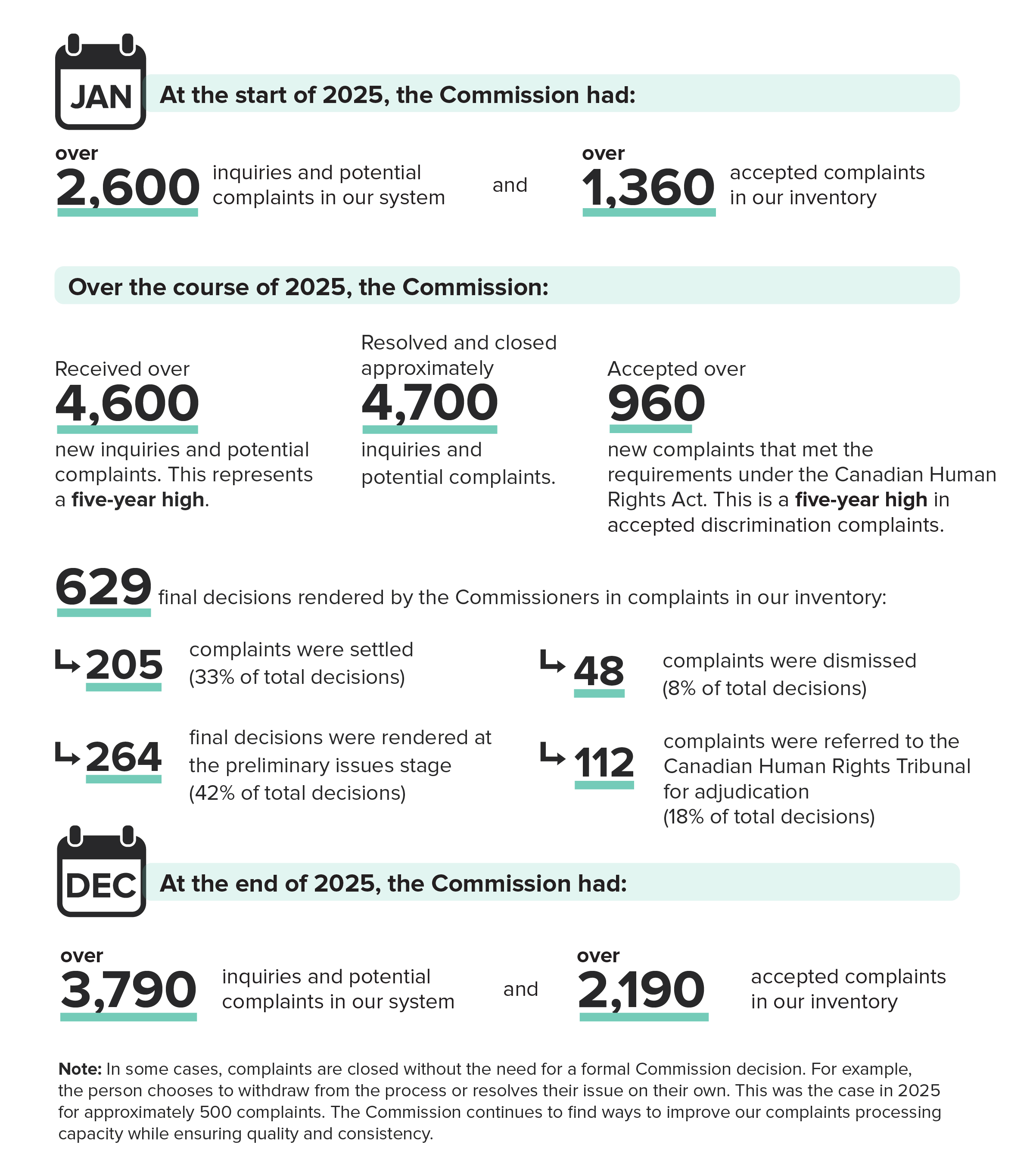
Our numbers at a glance - Text version
January: At the start of 2025, the Commission had:
- Over 2,600 inquiries and potential complaints in our system and
- Over 1,360 accepted complaints in our inventory
Over the course of 2025, the Commission:
- Received over 4,600 new inquiries and potential complaints. This represents a five-year high.
- Resolved and closed approximately 4,700 inquiries and potential complaints.
- Accepted over 960 new complaints that met the requirements under the Canadian Human Rights Act. This is a five-year high in accepted discrimination complaints.
629 final decisions rendered by the Commissioners in complaints in our inventory:
- 205 complaints were settled (33% of total decisions)
- 264 final decisions were rendered at the preliminary issues stages (42% of total decisions)
- 48 complaints were dismissed (8% of total decisions)
- 112 complaints were referred to the Canadian Human Rights Tribunal for adjudication (18% of total decisions)
December: At the end of 2025, the Commission had:
- over 3,790 inquiries and potential complaints in our system and
- over 2,190 accepted complaints in our inventory
- 172 discrimination complaints successfully resolved through mediation
- 112 discrimination complaints referred to the Tribunal
Employment Equity Act (January to December 2025)
- Six new employment equity audits launched of federally regulated employers in both public and private sectors that together employ approximately 10,000 employees
- Nine final audit reports issued for employment equity audits we launched in 2022 across various public sector departments, including one Crown corporation.
- Together, these organizations employ approximately 210,000 employees
Pay Equity Act (January to December 2025)
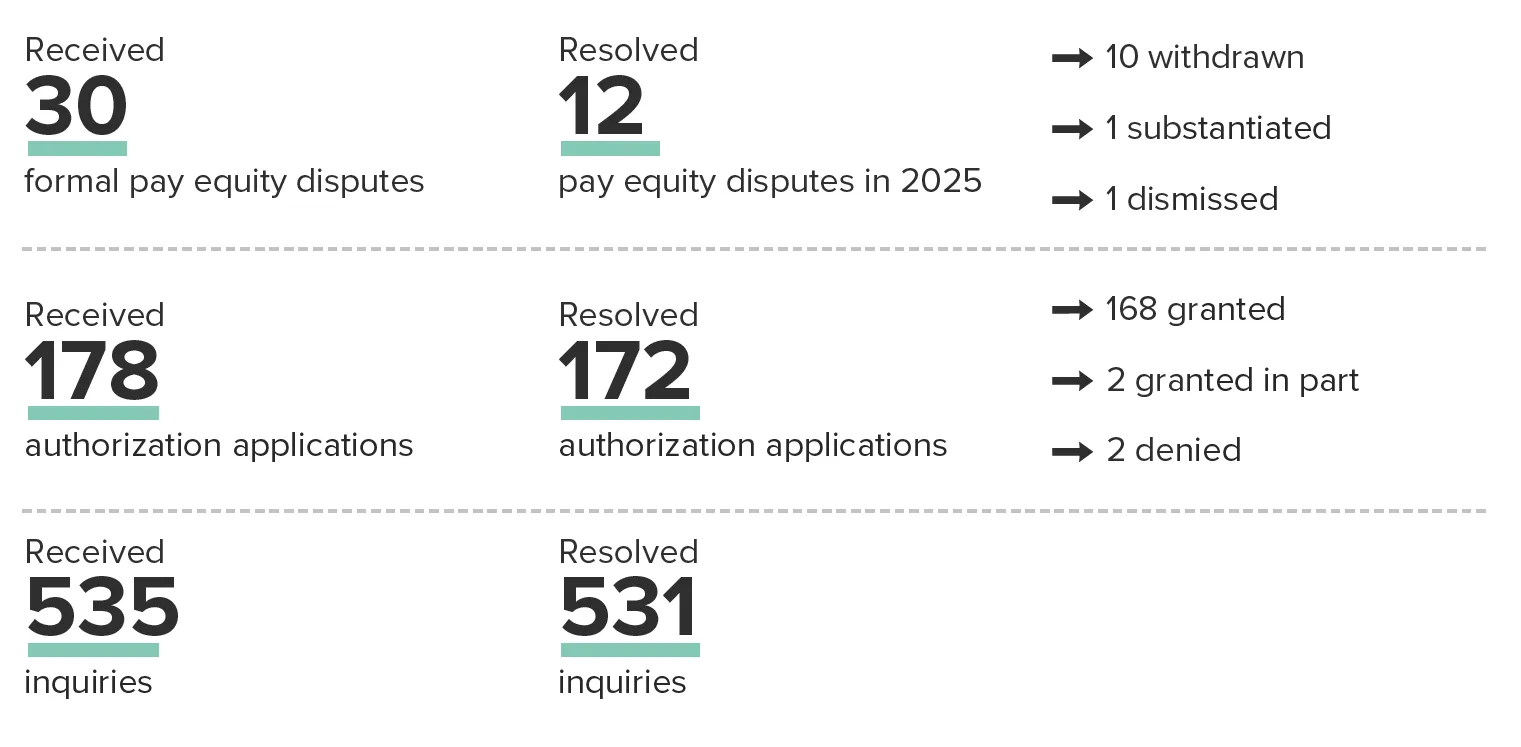
Pay Equity (January to December 2025) - Text version
- Received 30 formal pay equity disputes
- Resolved 12 pay equity disputes in 2025
-
- 10 withdrawn
- 1 substantiated
- 1 dismissed
- Received 178 authorization applications
- Resolved 172 authorization applications
-
- 168 granted
- 2 granted in part
- 2 denied
- Received 535 inquiries
- Resolved 531 inquiries
Accessible Canada Act (January to December 2025)
- Approximately 222 inspections completed
- Received 518 inquiries
- 0 complaints received and resolved
 Section 04: Advocating for human rights in Canada
What we do
We speak out, raise awareness, and advocate for human rights, accessibility and pay equity in Canada by:
- advising Parliament on new laws and emerging human rights issues
- supporting and conducting human rights research
- engaging with international bodies to raise concerns when Canada is not meeting its human rights obligations
- monitoring Canada's implementation of the United Nations Convention on the Rights of Persons with Disabilities
- publicizing key human rights settlements that have the potential to effect broader change across Canada
- supporting the Federal Housing Advocate in driving meaningful action and human rights-based solutions to housing need and homelessness in Canada
Contributing to the national discussion
A national voice
In 2025, we used our public platforms to engage Canadians, contribute to the national dialogue, and amplify key human issues in Canada, including:
- Advancing reconciliation is a shared human rights responsibility
- Canada is stronger when human rights are protected
- Canada must strengthen the human right to housing
- Canada's new homes can be both affordable and accessible
- An accessible Canada is a stronger Canada
- With equal pay, everyone benefits
- Women and girls are essential to Canada's path forward
- Calling on the Public Service to take concrete action to remove barriers for Black and other racialized people
- Human rights matter most in the hard times
Nurturing partnerships
In 2025, we strengthened partnerships across the disability and human rights ecosystem to ensure our work is informed by lived experience, grounded in evidence, and responsive to real-world barriers. We worked alongside disability rights organizations and networks, with research centres, with academic and cultural institutions, with advocates and respondents as part of our complaints process stakeholder network, with national security bodies, and with anti-racism advocates. These partnerships informed policy development, advanced rights-based and equity-focused approaches, deepened our understanding of accessibility barriers, and supported continuous improvement of our complaints processes.
Holding Canada to account on international obligations
We make submissions each year to various United Nations (UN) bodies on whether Canada is upholding its human rights obligations. Through our UN submissions, we raise new and emerging human rights concerns and draw attention to longstanding inequities.
We approach this work with a clear intention to support the Second International Decade for People of African Descent. In support of the Decade's recognition pillar, we remain committed to fostering dialogue on racism and discrimination by approaching all our international submissions through an anti-racism lens. We also carry out this work with a steadfast commitment to upholding and advancing the rights of Indigenous Peoples by promoting equality, addressing discrimination, and supporting the implementation of the United Nations Declaration on the Rights of Indigenous Peoples.
Disability rights
A key 2025 highlight was our participation in the United Nation's review of Canada's disability rights record. We emphasized that Canada must do more to protect the right of people with disabilities to an adequate standard of living. People with disabilities make up more than 27% of the Canadian population. Yet, upholding and advancing disability rights, and making meaningful progress remains elusive. There is still much work to be done.
We raised serious concerns that some people with disabilities are turning to Medical Assistance in Dying (MAiD) because they feel they have no other options, which is unacceptable. We made key recommendations, including improving human rights implementation across governments, collecting better data, reviewing how MAiD is used, strengthening the Canada Disability Benefit, protecting the right to adequate housing, addressing homelessness, and improving oversight in places of detention. The UN Committee's recommendations echoed our concerns, and we will continue to use them to advance disability rights in Canada.
The Chief Commissioner spoke at the annual meeting of the Global Alliance of National Human Rights Institutions in Geneva. She highlighted the role of national human rights institutions in advancing disability rights through collaboration, knowledge sharing, and advocacy.
Read more:
- Full Submission to the Committee on the Rights of Persons with Disabilities
- At a glance submission to the Committee on the Rights of Persons with Disabilities
- Opening remarks to the Committee on the Rights of Persons with Disabilities
Additional highlights
| Human rights issue | What we emphasized to the United Nations |
|---|---|
|
Rights of Indigenous Peoples Submission to the UN Expert Mechanism on the Rights of Indigenous Peoples This was in response to their “call for input on a study on Indigenous Peoples right to data, including data collection and disaggregation.” |
|
|
Rights of people released from detention Submission to the UN Office of the High Commissioner for Human Rights This was in response to their “call for input for a study on human rights and the social reintegration of persons released from detention and persons subjected to non-custodial measures.” |
|
|
Rights of people of African descent in the criminal justice system Submission to the UN Independent Expert Mechanism to Advance Racial Justice and Equality in Law Enforcement This was in response to their “call for input on systemic racism against Africans and people of African descent in the criminal justice system.” |
|
|
Rights of students to safety in education Submission to International Expert on Sexual Orientation and Gender Identity, as part of their “call for input on safety in education” Our submission provided information on the right to health and freedom from discrimination for 2SLGBTQI+students. This is an issue the Commission has been vocal on in recent years. In addition, at the very end of 2024, we made a submission to the UN Special Rapporteur on the Right to Education. |
|
|
Rights of people deprived of their liberty Our statement during the 60th session of the Human Rights Council and its interactive dialogue with the Working Group on Arbitrary Detention, concerning their visit to Canada Our statement was delivered by the Global Alliance of National Human Rights Institutions (GANHRI) on our behalf. |
Three areas of ongoing concern in Canada:
|
|
Right to a safe, clean, healthy and sustainable environment A statement on human rights and the environment to RINDHCA (in Spanish) (our regional network of National Human Rights Institutions) |
|
Serving as a national monitoring mechanism
Since 2019, we have served as Canada's federal organization responsible for monitoring Canada's implementation of the United Nations Convention on the Rights of Persons with Disabilities. When we do this work, we are known as the National Monitoring Mechanism (NMM). Under this role, we track progress, identify gaps, and work with people with disabilities, their organizations, and their families to promote real change.
In 2025, we continued to collect and analyze data on the right to adequate housing for people with disabilities. Together with the Federal Housing Advocate, we published a report that summarizes data on the right to adequate housing for people with disabilities. This 2025 report provides recommendations to help advance the right to adequate housing for people with disabilities in Canada, including recommendations to address data gaps.
The indicator results show that people with disabilities have worse housing outcomes than people without disabilities. The data shows that people with disabilities are more likely to:
- miss housing payments because of financial challenges or issues
- have unsafe drinking water, poor air quality, and issues with bugs and mold
- live in homes that need major repairs
- not get the supports they need to live independently
- not feel like part of their communities
- feel unsafe in their homes
We are using these results to advocate for change. For example, we shared these results with the United Nations for Canada's recent review under the Convention on the Rights of Persons with Disabilities.
Supporting the Federal Housing Advocate
The Commission continued to support the Federal Housing Advocate, Marie-Josée Houle, and her office, in their work over the course of 2025.
The Federal Housing Advocate continued to be a leading national voice on the mounting crisis of homelessness and unaffordable housing in Canada. Here are just a few of the 2025 highlights:
- helping amplify the concerns submitted to her from people across Canada and ensuring their voices are part of the national conversation, with over 400 mentions in various national Canadian media
- urging Canada's premiers to respect the human rights of encampment residents in an open letter, and publishing a guide on how to integrate a human rights practices into encampment responses
- partnering with Canada's Accessibility Commissioner to signal to the federal government that Canada's next generation of homes can be both affordable and accessible for all
- publishing a comprehensive report and urgent recommendations to the federal housing minister on how Canada can expand non-market housing in a way that keeps human rights front and centre
- calling on the National Housing Council to launch a review panel to examine the lack of accessible housing across Canada
- calling for sustained federal investments to support human rights-based approaches to encampments
The timing of this work is critical. With Canada's cost-of-living crisis and homelessness crises surging, the voices of people most affected in Canada and the recommendations of the Federal Housing Advocate must help inform solutions.
 Section 05: Resolving human rights complaints
What we do
We help protect human rights in Canada by:
- receiving and screening complaints from people who believe they have experienced discrimination, harassment, and other barriers to pay equity and accessibility
- helping people resolve disputes and obtain meaningful individual and systemic remedies through mediation and conciliation
- referring complaints to the independent Canadian Human Rights Tribunal when the Commissioners determine further inquiry is warranted
- representing the public interest in certain cases that go before the Canadian Human Rights Tribunal and Canada's courts
A clearer path to justice for everyone
In recent years, we have made our process easier to navigate.
In 2025, we focussed on:
- providing complaints staff with trauma-informed training, as well as a deeper understanding of intersectionality — which is when a racialized person's other identities, such as gender identity or disability, compound the effects of racism, discrimination, harassment
- creating a safe and supportive space for complainants from their first interaction with the Commission
- updating our Accommodation Policy for Members of the Public, and making it available in ASL and LSQ
- launching a review of our Complaint Rules, inviting the public to share their feedback
- ensuring that meaningful feedback from the people who use our process informs our plans to update and refine our online complaint platform
- creating of a special internal taskforce that focuses only on race-based discrimination complaints under the Canadian Human Rights Act
Serving a diverse Canada
In recent years, we conducted a voluntary survey among people who use our discrimination complaints process. The survey was shared with anyone who submitted a complaint to the Commission in the 2023–24 or 2024–25 fiscal years.
We wanted to gain a better understanding of who is using our complaints process under the Canadian Human Rights Act and why. We will use the survey data to improve our complaints process and better serve the diverse communities who rely on it as a path to justice.
A total of 783 people (an overall response rate of 22%) filled out our survey asking them to self-identify under various demographic categories.
An independent third-party organization collected and analyzed the data, comparing the results with data from Canada's Census. What they found is that overall, the diverse population of survey participants using our complaints process reflects the diversity of the Canadian population. In some cases, the representation of a particular group of survey participants using our complaints process is higher than their representation in the general population.
Of important note, we cannot compare our survey data on 2SLGBTQI+ survey participants to Canadian Census data, since the Census data is unavailable. What our survey results do tell us is that:
-
15% of survey participants reported having a sexual orientation other than heterosexual:
- 6% who self-identified as gay or lesbian
- 5% bisexual or pansexual
- 1% Two-Spirit
- 3% who use a different term
- 10% preferred not to respond to that portion of the survey
- 2% of complainants self-identified as trans
- 76% of the people who participated in our survey self-identified as straight or heterosexual
Results of survey to complainants
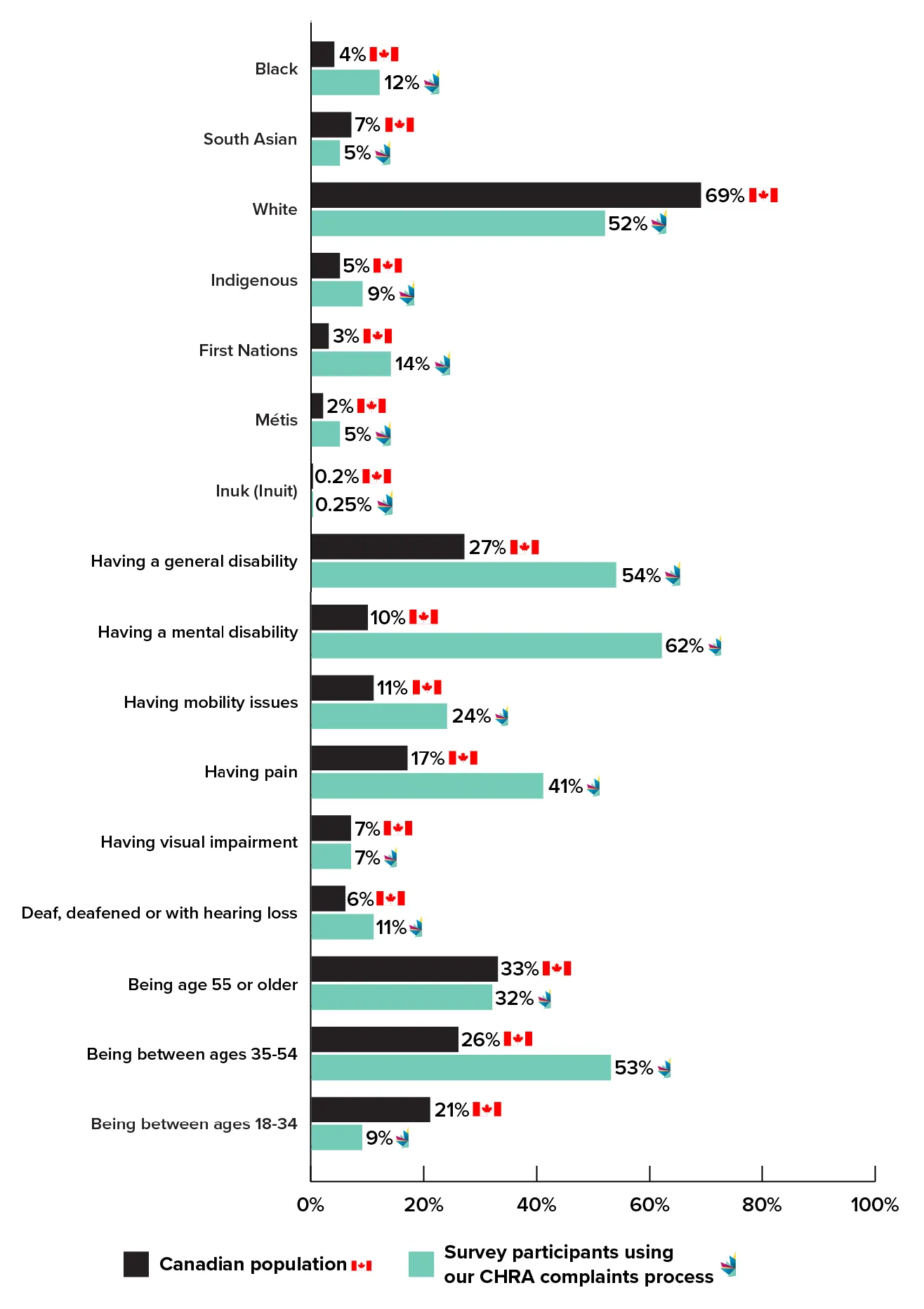
Results of survey to complainants - Text version
| People who self-identify as: | Canadian population |
Survey participants using our complaints process |
|---|---|---|
| Black | 4% | 12% |
| South Asian | 7% | 5% |
| White | 69% | 52% |
| Indigenous | 5% | 9% |
| First Nations | 3% | 14% |
| Métis | 2% | 5% |
| Inuk (Inuit) | 0.2% | 0.25% |
| Having a general disability | 27% | 54% |
| Having a mental disability | 10% | 62% |
| Having mobility issues | 11% | 24% |
| Having pain | 17% | 41% |
| Having visual impairment | 7% | 7% |
| Deaf, deafened or with hearing loss | 6% | 11% |
| Being age 55 or older | 33% | 32% |
| Being between ages 35-54 | 26% | 53% |
| Being between ages 18-34 | 21% | 9% |
By the numbers: 2025 trends in discrimination complaints
Each year, the Commission helps thousands of people who come to us because they believe they have been discriminated against. We can help most without them having to file a formal complaint under the Canadian Human Rights Act.
Here is a snapshot of what the complaints we accepted in 2025 reveal.
Discrimination complaints by ground
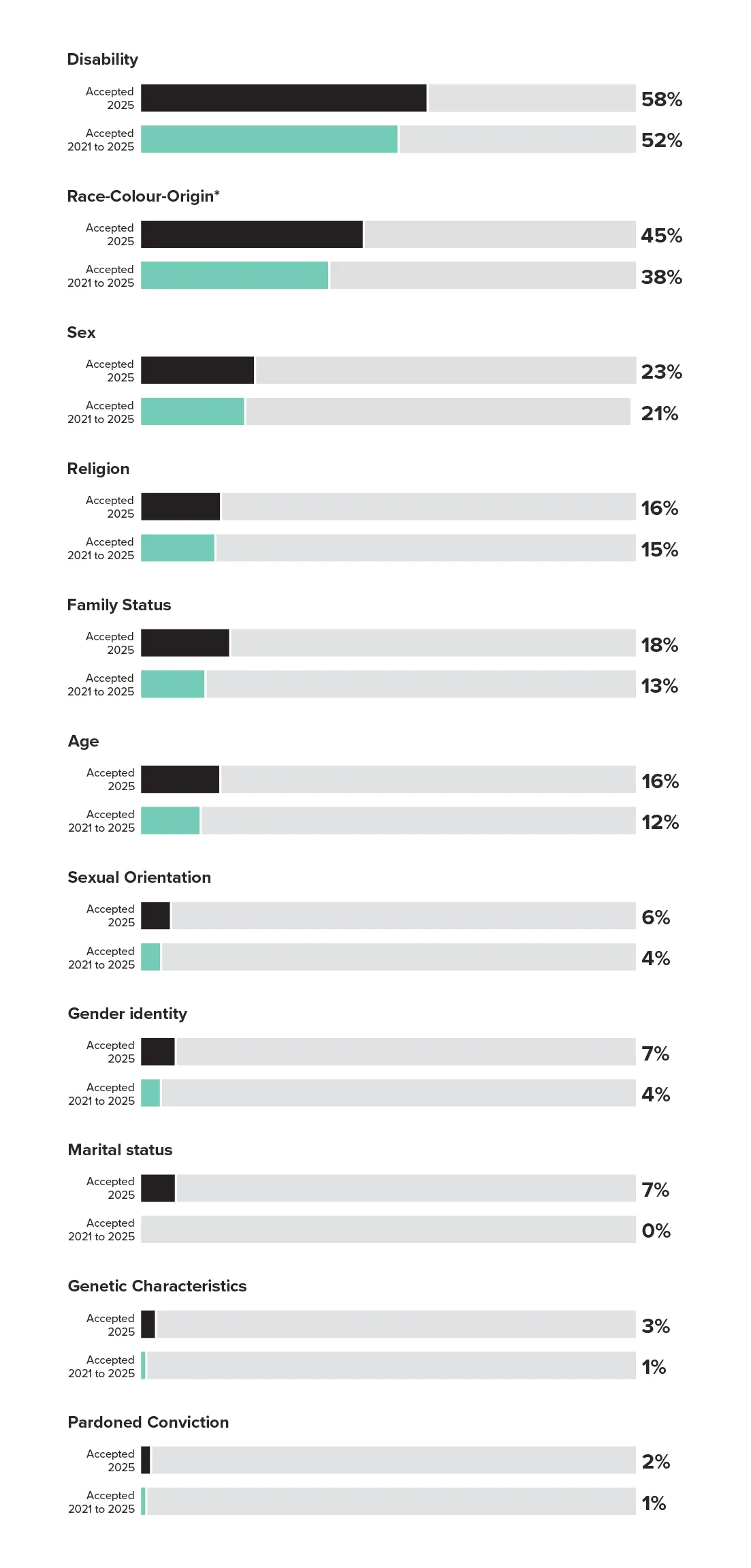
Discrimination complaints by ground - Text version
| Complaints by grounds | Accepted in 2025 |
Accepted from 2021 to 2025 |
|---|---|---|
| Disability | 58% | 52% |
| Race-Colour-National/Ethnic OriginTable note * | 45% | 38% |
| Sex | 23% | 21% |
| Religion | 16% | 15% |
| Family status | 18% | 13% |
| Age | 16% | 12% |
| Sexual orientation | 6% | 4% |
| Gender identity | 7% | 4% |
| Marital status | 7% | 0% |
| Genetic characteristics | 3% | 1% |
| Pardoned conviction | 2% | 1% |
Discrimination complaints by location
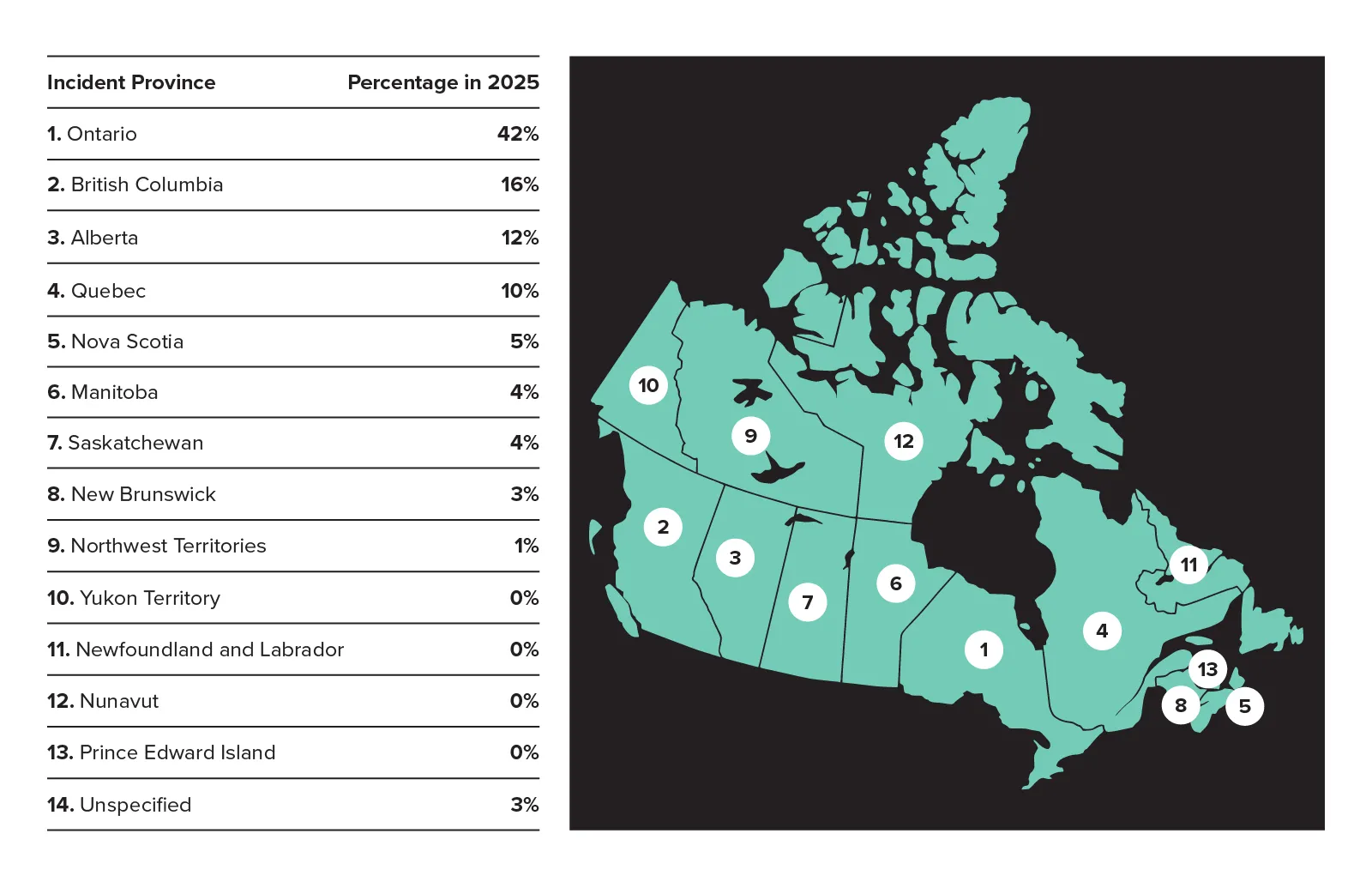
Discrimination complaints by location - Text version
| Incident province |
Complaints in 2025 |
|---|---|
| Ontario | 42% |
| British Columbia | 16% |
| Alberta | 12% |
| Quebec | 10% |
| Nova Scotia | 5% |
| Manitoba | 4% |
| Saskatchewan | 4% |
| New Brunswick | 3% |
| Northwest Territories | 1% |
| Yukon Territory | 0% |
| Newfoundland and Labrador | 0% |
| Nunavut | 0% |
| Prince Edward Island | 0% |
| Unspecified | 3% |
Discrimination complaints by jurisdiction
- Federal Government: 57%
- Transportation: 16%
- Finance / banking: 13%
- Communications: 4%
- Reserves / band councils: 6%
- Unions: 1%
- Other / unknown: 4%
Discrimination complaints with special focus
-
50% of disability complaints accepted by the Commission were related to mental health.
This represents 29% of complaints accepted by the Commission in 2025. - 24% of complaints accepted in 2025 cited more than one ground of discrimination.
- 26% of complaints accepted in 2025 cited harassment.
By the numbers: Race-based discrimination complaints
Changes we have made to our complaints process are continuing to make a meaningful difference. These changes have been based on expert recommendations — from improving the way we use evidence to assess the cases we refer to the Canadian Human Rights Tribunal, to deepening employee understanding of how systemic racism manifests in society.
The number of race-based discrimination complaints Commissioners refer to the Canadian Human Rights Tribunal continues to be higher than our rate of referrals in other complaints. This has been true since 2020. And the number of race-based complaints Commissioners dismiss continues to be equal or lower than our rate of dismissals of other complaints. This has been true since 2021.
In 2025, the Commissioners made 272 decisions in race-based complaints (complaints citing any of the grounds of race, colour, and/or national or ethnic origin)
- Referred to the Canadian Human Rights Tribunal: 21% (58 cases)
- Dismissed: 8% (21 cases)
- Final decisions at the preliminary issues stage: 35% (96 cases)
- Approved settlements through mediation or conciliation: 36% (97 cases)
2025 decisions in complaints citing any of the grounds of race, colour, and/or national or ethnic origin
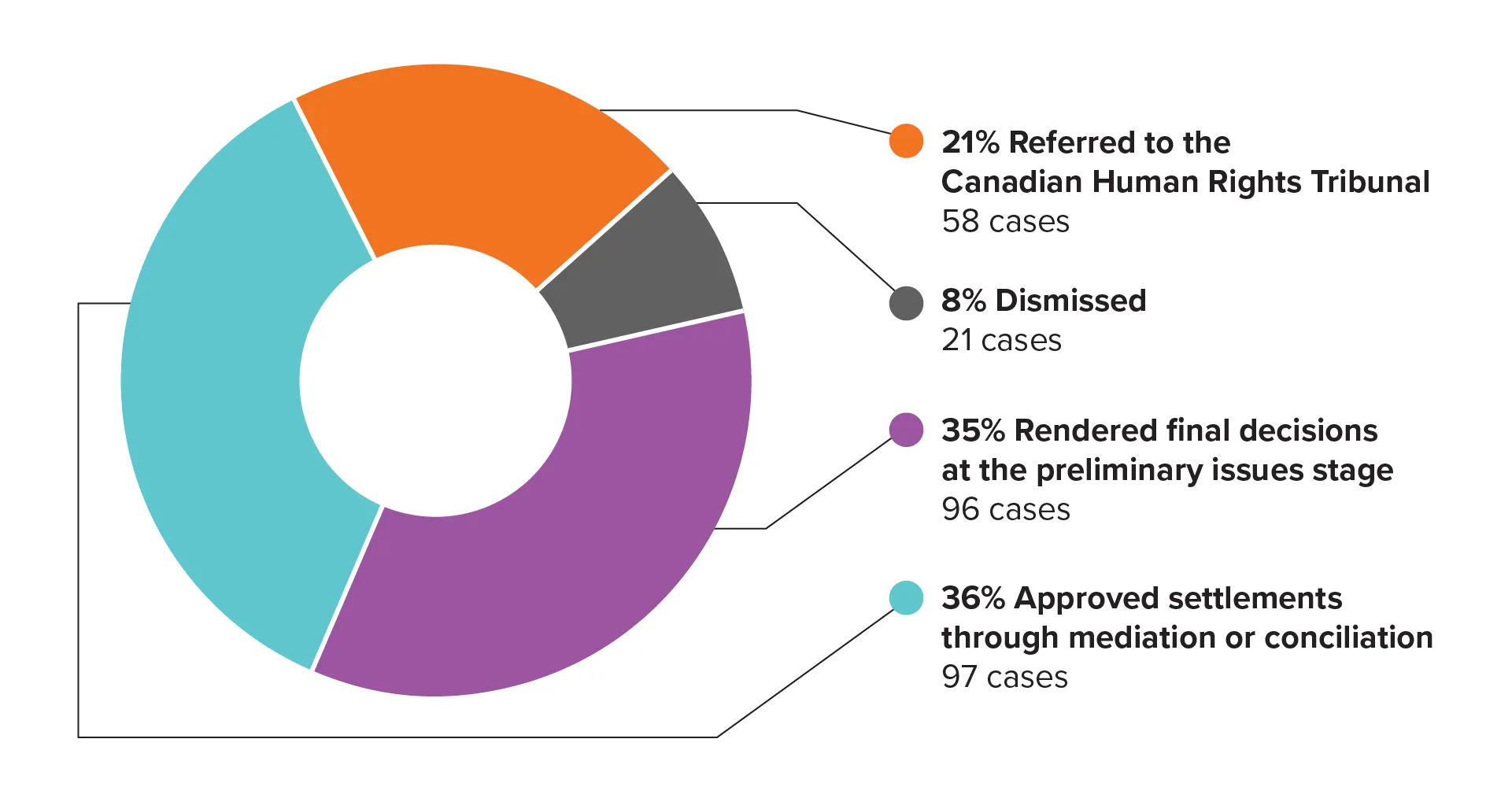
2025 decisions in complaints citing any of the grounds - Text version
- Referred to the Canadian Human Rights Tribunal: 21% (58 cases)
- Dismissed: 8% (21 cases)
- Rendered final decisions at the preliminary issues stage: 35% (96 cases)
- Approved settlements through mediation or conciliation: 36% (97 cases)
2025 decisions in all complaints
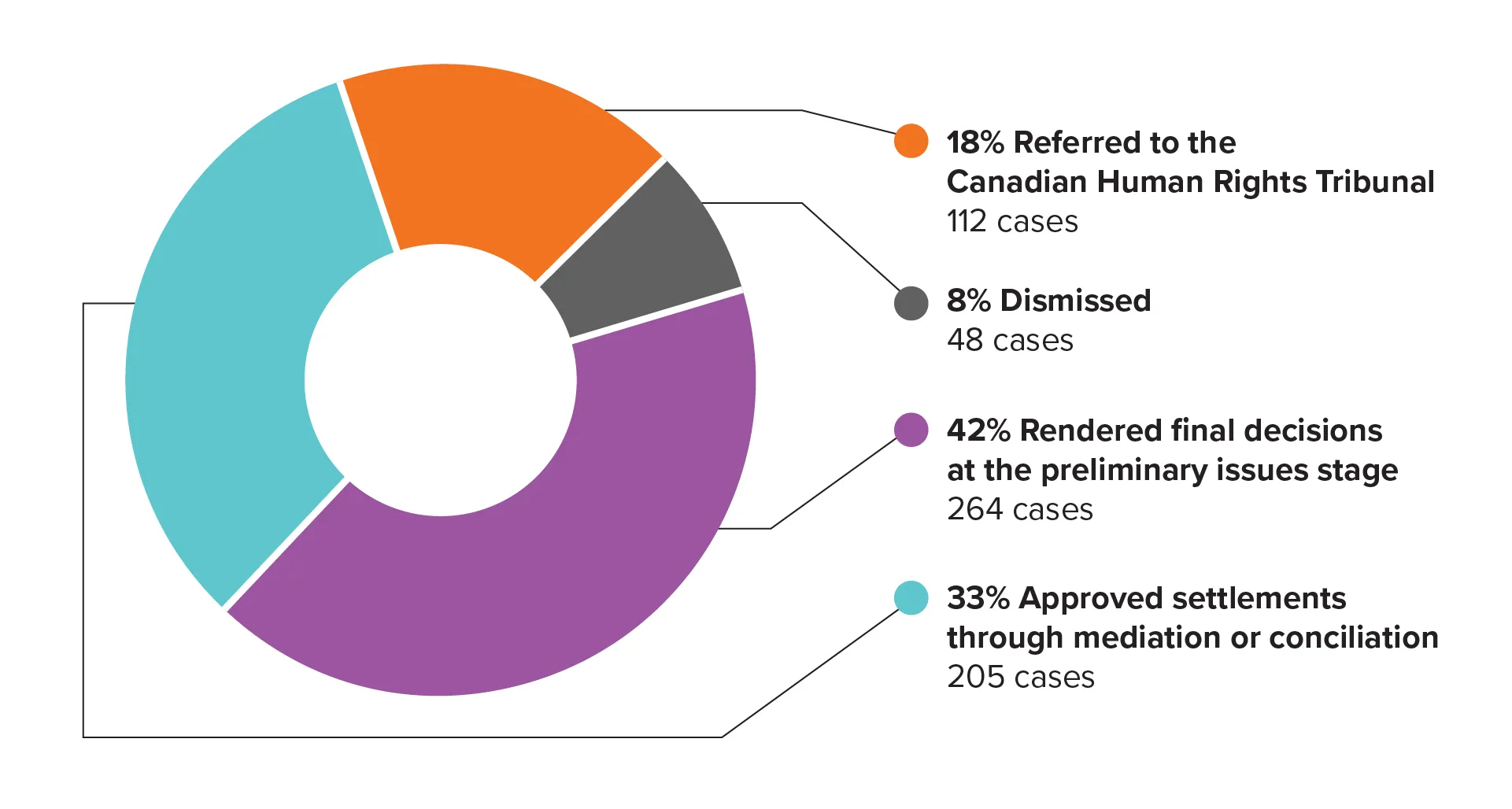
2025 decisions in all complaints - Text version
- Referred to the Canadian Human Rights Tribunal: 18% - (112 cases)
- Dismissed: 8% - (48 cases)
- Rendered final decisions at the preliminary issues stage: 42% - (264 cases)
- Approved settlements through mediation or conciliation: 33% - (205 cases)
Helping resolve disputes through mediation
Mediation is a service offered by the Commission at no cost to the participants. It gives people the opportunity to tell their story in a less adversarial environment. Mediation serves as an alternative to a court proceeding. It is not a court hearing. It is a facilitated negotiation between two parties. Our priority is always to create an environment of empathy during our mediations. We want everyone to feel heard. We want everyone to have as much time as they need to tell their side of the story.
In 2025, we helped bring 172 discrimination complaints to successful resolution through mediation (which is voluntary) or conciliation (which is mandatory).
The complaints we helped resolved have led to tangible outcomes across various federal organizations, including:
- updated policies on parental and family leave
- mandatory training for their employees, particularly those in front line positions, to address unconscious bias, anti-racism, accommodation requests, harassment and discrimination in the workplace
- accessibility improvements to their websites to facilitate screen readers and keyboard navigation
- policy changes and reviews by service providers and employers on anti-racism, accommodation, harassment and discrimination
- new policies and procedures or improving existing ones to ensure that discrimination within the workplace or in the service of Canadians will not be tolerated
The Commission is updating mediation training material to ensure our mediators have the most up to date skills and practices. We are also actively working to align our mediation process to include mediation services for complaints and disputes under the Pay Equity Act and the Accessible Canada Act.
Representing the public interest in cases of systemic discrimination
When the Commissioners refer a discrimination complaint under the Canadian Human Rights Act to the Canadian Human Rights Tribunal for adjudication, the Commission also decides whether it will participate in the case on behalf of the public interest. That means we are there to bring the systemic human rights issues in a case to the forefront.
The Commission can also choose to participate in cases that could have far-reaching implications for human rights in Canada. These cases do not have to necessarily begin as a complaint to the Commission. This strategic litigation aims to strengthen and reinvigorate human rights case law and support people who have experienced discrimination, especially in cases brought on the grounds of race, colour and national and ethnic origin.
In 2025, Commissioners referred 112 cases to the Canadian Human Rights Tribunal. The Commission represented the public interest in 138 out of a total of 257 complaints at the Tribunal. This work includes participating in hearings, mediations, and case management conferences.
The Tribunal is an entirely separate and independent organization from the Commission and works like a court — with hearings where testimony and evidence are presented. Only the Tribunal can decide whether or not discrimination has taken place.
Of the cases the Commissioners referred to the Tribunal in 2025:
- 50% were related to discrimination in receiving a service
- 42% were related to discrimination in employment
- 23% involved allegations of harassment
Race-based complaints represented an average of 51% of our Tribunal caseload. Of the complaints referred by Commissioners to the Tribunal in 2025, we participated in 50% of the race-based cases. This includes making legal arguments and presenting evidence in many of the cases, as well as participating in mediation and case management.
This part of our work aligns with the Second International Decade for People of African Descent. In support of the Decade's justice pillar, we continue to take steps to strengthen protections and advance access to justice through our complaints process as well as strategic litigation, including for people of African descent.
Key human rights cases in which we represented the public interest in 2025
| About the case and what's at stake | 2025 update |
|---|---|
|
The rights of religious minorities in Canada The Commission continues to participate in legal challenges against Quebec's Bill 21 (An Act Respecting the Laicity of the State), which prohibits government employees in positions of authority, including teachers, from wearing religious symbols or headdresses. The Quebec government invoked the notwithstanding clause to shield the law from any constitutional challenges. |
This case is now going to the highest court in our country. When the hearing takes place before the Supreme Court of Canada, the Commission will be an intervenor. |
|
The right to live free from racial discrimination The Complainant alleges that they were discriminated against by Air Canada employees based on several protected characteristics, including race. Air Canada maintains that discrimination did not happen. They are invoking something known as the Montreal Convention. It is a legal convention that limits financial compensation to air passengers to only situations involving death, injury, and loss or damage to baggage. The convention does not include compensation for racial discrimination. |
On behalf of the public interest, the Commission is arguing before the Canadian Human Rights Tribunal that Air Canada violated the Canadian Human Rights Act. The Commission is arguing that the Tribunal can award the Complainant monetary damages. |
|
The right to education for First Nations students The Complainant alleges that the federal funding formula for First Nations education is based on a standard provincial funding formula that fails to properly account for the higher costs of on-reserve education and for the unique needs of First Nations students. They argue this results in educational gaps for First Nations children who end up lagging far behind the general population. |
For decades, the Commission has advocated and litigated about what we know to be a fundamental and deeply rooted inequality in educational services provided on First Nations reserves, funded by the federal government. In October 2025, the hearing began before the Canadian Human Rights Tribunal The hearing is expected to conclude in early 2026. |
|
The rights of people with disabilities to travel freely and easily Accessibility legislation should never be used to limit the human right of persons with disabilities to receive individual accommodation. When Air Canada told a passenger they could not accommodate the size of their power wheelchair because the cargo doors on the flight were too small to store it, the passenger was told the only alternative they could be offered was an indirect flight that included a 13-hour layover. The passenger, now the Complainant, submitted a complaint against Air Canada with the Canadian Transportation Agency in 2018, outlining the barriers they faced and several recommended corrective measures. |
Throughout the litigation, Air Canada maintained that they complied with accessibility regulations in denying the service. The Commission participated when this case went to the Federal Court of Appeal. We argued that Canada's accessibility laws and regulations are meant to be the “floor,” not the “ceiling.” The Federal Court of Appeal agreed. This decision represents an acknowledgement that accessibility laws operate to set a minimum on the duty to accommodation and not a maximum. |
|
The rights of Black and racialized public servants The Complainant alleged that Canada Revenue Agency discriminated against him based on race, colour and national or ethnic origin. The Commission argued before the Canadian Human Rights Tribunal that the evidence supported the allegations of systemic and individual discrimination and harassment. |
The Commission has sought a judicial review of the Tribunal's decision. At the close of 2025, we are awaiting a hearing date. |
 Section 06: Preventing discrimination and eliminating barriers
What we do
Empowered by a series of federal laws, we work to address and prevent discrimination and human rights issues in Canada by:
- under the Employment Equity Act, auditing federally regulated employers to ensure they are taking steps to increase representation across Canada's workplaces for women, Indigenous people, racialized people and people with disabilities
- under the Pay Equity Act, supporting the Pay Equity Commissioner in carrying out their mandate to ensure that federally regulated employers comply with the Act and work towards a Canada where the right to equal pay for work of equal value is a reality for all
- under the Accessible Canada Act, supporting the Accessibility Commissioner in carrying out their mandate to promote, monitor, and oversee compliance with the Act among federally regulated organizations, in support of a barrier-free Canada.
- as a federally regulated employer, putting our values into practice and maintaining an unwavering commitment to ongoing progress in, inclusion, diversity, equity, accessibility, and anti-racism (IDEA-AR)
Monitoring compliance with the Employment Equity Act
Under the Employment Equity Act, we conduct three main types of audits:
- employer-specific (also known as conventional)
- issue-based (also known as horizontal)
- requirement-based (also known as blitz)
The work that a single employment equity audit entails can often span multiple years, depending on the size and scope. In a given year, we are launching a number of new audits and also continuing work on ongoing audits initiated in recent years.
In 2025, we launched six new employment equity audits:
- five conventional audits launched, including preliminary assessments, of five private sector federally regulated employers
- one new blitz audit launched, and the preliminary assessment completed
- these audits spanned both public and private sector organizations that together employ approximately 10,600 employees
We also issued nine final audit reports for employment equity audits we launched in 2022 across various public sector departments, including one Crown corporation. Together, these organizations employ approximately 210,000 employees. And we completed each of the preliminary assessments for the 14 blitz audits we launched last year.
Key 2025 employment equity highlights
Significant barriers for racialized people seeking management and executive positions in the federal public service
In March 2025, we released our much-anticipated sector-wide horizontal audit report. It confirmed through employment equity data that racialized people in the federal public service, particularly those seeking management and executive positions, still face significant barriers to being hired or promoted. Our audit revealed the most frequently identified barriers are related to recruitment strategies, selection processes, hiring decisions, career development, and workplace culture.
Of the 46 departments and organizations that submitted a self-assessment survey, 33 of them said they had undertaken a review to identify barriers to hiring or promoting racialized people to management or executive positions. As the result of these reviews, 63.6% reported they had identified barriers.
In our public release, we stated that as an employer to over 300,000 employees, the federal public service should be a leader in employment equity, and must set a positive example for others in the Canadian labour market.
Update on our horizontal audits within the ground, air, and water transportation sectors
- We issued six audit reports out of the eight audit files under the horizontal audit on racialized people in the ground transportation. Two reports are outstanding and will be issued in early 2026. We closed two of the eight audit files.
- We drafted audit reports for the five horizontal audit files on women in management positions in the air transportation sector. The reports are expected to be issued in early 2026.
- We issued employment equity surveys to 40 employers as part of the horizontal audit on people with disabilities in the water transportation sector. The five employers selected for audits will be notified in January 2026.
Supporting the modernization of the Employment Equity Act
We continue to support ongoing efforts to modernize the Employment Equity Act (EEA). We have consistently advocated that comprehensive reform and modernization of the EEA is overdue. We believe this reform can support both greater accountability and greater public trust.
We maintain that Canada needs the EEA to be a more modern tool that can more effectively address historical harms as well as persistent, systemic inequities. When people in Canada can see themselves in the institutions where they work and receive services, it promotes greater public trust and a stronger society for all.
In 2025, we continued to meet with partners and rights-holders for whom reform of the EEA is a significant priority. We will continue to ensure their voices inform our advice to Parliament.
Monitoring compliance with the Pay Equity Act
Canada's Pay Equity Commissioner, Lori Straznicky, now in her third year in her federal role, saw promising momentum among federally regulated employers over the course of 2025. While some employers are still seeking extensions to post their final pay equity plans, which were due last fall, we are seeing awareness and concrete action among many others. It's a promising sign that while progress may not happen overnight, gradual steps make all the difference.
This past year marked a significant milestone. As stipulated in the Pay Equity Act, June 30, 2025 was the designated date for all federally regulated employers to submit their very first annual statements to the Pay Equity Commissioner. It is essentially a pay equity progress report, and they will now be expected to submit one each year. Other than our future pay equity audits, the annual statements from employers are a significant, concrete way that the Commissioner Straznicky can know for sure if an employer has put their pay equity plan into action.
With a strong commitment to advocacy and collaboration, the Pay Equity Commissioner continued to nurture relationships with partners and stakeholders, key among them was her 2025 engagement with Kadie Philp, Ontario's Pay Equity Commissioner. This engagement supported alignment on best practices to advance pay equity across jurisdictions.
In 2025, we introduced the Pay Equity Annual Statement Portal to help make it easier for employers to report annually to the Pay Equity Commissioner on their obligations. We were encouraged this summer to see several annual statements already submitted.
Some employers, however, are falling behind on their obligations. For this reason, we are now looking ahead to putting a formal set of enforcement tools in place. Last year, the Pay Equity Commissioner gave the heads-up to employers and unions that this necessary next step was coming. Our forthcoming framework of pay equity audits — which will include administrative monetary penalties — will help us reinforce the spirit of the Pay Equity Act, and ensure compliance over the long-term.
A more comprehensive update on all of this, including updated statistics on the number of disputes submitted to the Pay Equity Commissioner will soon be available in the Pay Equity Commissioner's own Annual Report to Parliament.
Monitoring compliance with the Accessible Canada Act
Christopher T. Sutton was appointed Accessibility Commissioner in May 2025. His approach to the role has been grounded in lived experience, with a strong focus on systemic change. He has focused the early months of his new mandate on advocacy, outreach, and engagement.
Over the year, the Accessibility Commissioner engaged with partners and civil society groups across Canada. He was invited to play an active role in several public forums and events, including the Global Government Forum, AccessFest, the Canadian Hard of Hearing Association National Conference, the Disability and Work Conference, meetings of the Accessibility Standards Canada Board, and events marking the International Week of the Deaf and Sign Languages. As part of this work, Commissioner Sutton had the honour of raising the Deaf flag on Parliament Hill, underscoring the importance of Deaf culture, sign languages, and lived experience in advancing accessibility and human rights in Canada.
Across these discussions, conferences, and conversations, the Accessibility Commissioner consistently centred accessibility as a lived reality, drawing on his own experience as a person with a disability. This perspective informed a practical and grounded approach to engagement, helping to surface where barriers persist and how accessibility requirements are being implemented across different sectors.
In addition to community and civil society engagement, the Accessibility Commissioner met extensively with federally regulated entities and federal departments to advance compliance and shared understanding of accessibility obligations. These discussions focused on emerging and cross-cutting issues that matter to all Canadians, including accessibility considerations in artificial intelligence and digital systems, housing, and the built environment. The Commissioner also emphasized that accessibility is an economic driver and a critical component of the investments Canada is making today to build a stronger, more resilient, and more sovereign country. Embedding accessibility early in policy, program, and system design helps ensure those investments deliver lasting value for everyone.
All of this advocacy work in 2025 was guided with a keen understanding that advancing accessibility is a journey — one that must be taken together, at all levels, across government, industry and communities. Meaningful progress requires sustained collaboration, shared responsibility, and long-term commitment.
At the same time, the Accessibility Commissioner and Commission staff continued to monitor and assess organizations' compliance with the Accessible Canada Act through inspections. The results of this work provide important insight into the current state of compliance across federally regulated organizations.
More comprehensive updates and statistics on this work will soon be available in the Accessibility Commissioner's own Annual Report to the Minister of Jobs and Families.
Putting values into practice
As a federally regulated employer, the Commission is committed to providing a safe, inclusive, and barrier-free environment for everyone.
In 2025, we continued to imbed the principles of inclusion diversity equity accessibility and anti-racism (IDEA-AR) in all that we do. We are ensuring Commission-wide accountability to this work through performance objectives for employees and executives.
| IDEA-AR pillar | 2025 highlights |
|---|---|
| Inclusion |
|
| Diversity |
Verified Treasury Board data up to 2024 shows our over-representation of women, racialized persons, and people with disabilities, with a slight gap for Indigenous employees. This data is based on voluntary reporting from federal employees:
The area in which we could most improve is Indigenous representation at the Commission. Approximately 1 in 39 employees at the Commission identify as Indigenous. Our 2025 data is under validation by the Treasury Board Secretariat and will be released early 2026–27, but trends remain consistent. |
| Equity |
|
| Accessibility |
|
| Anti-racism |
|